About Hakea ulicina R.Br.
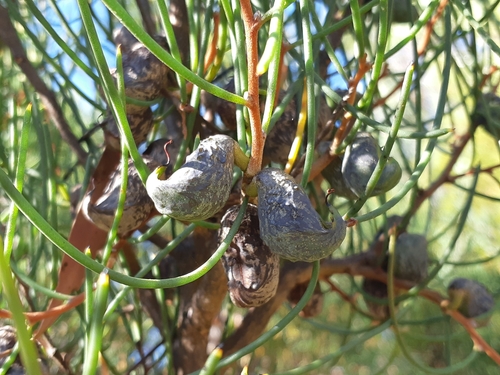
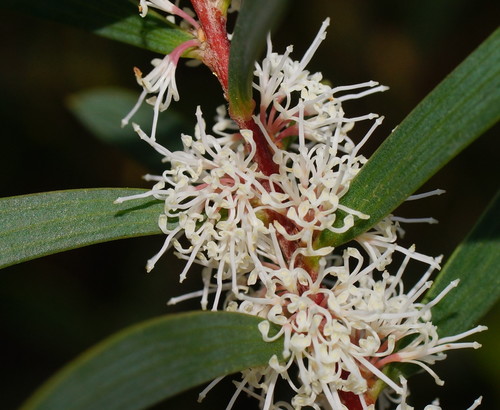
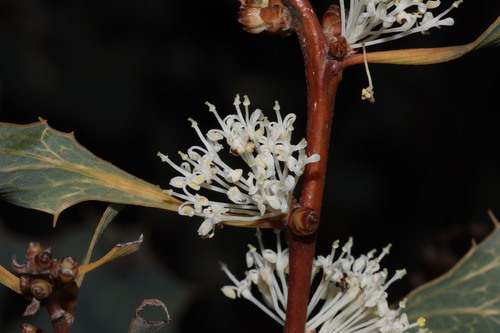
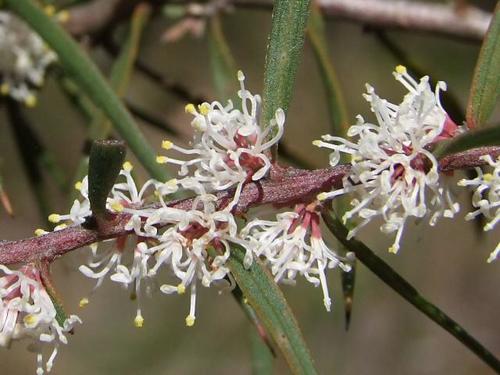
Hakea ulicina, commonly called furze hakea, is an erect shrub or small tree that grows between 2 and 5 metres (7 and 20 feet) tall, and resprouts from a lignotuber. Its leaves are mostly linear, curved, and rigid, measuring 3 to 18 centimetres (1 to 7 inches) long and 1 to 4 millimetres (0.04 to 0.2 inches) wide, with 1 to 3 prominent longitudinal veins on both the upper and lower surfaces. White flowers grow in clusters of 6 to 18 in leaf axils, and the pistil of the flower is 4 to 6 millimetres (0.16 to 0.24 inches) long. Flowering takes place from late winter to spring. The fruit are ovate or obliquely ovate, measuring 1.6 to 2.5 centimetres (0.6 to 1 inch) long and 8 to 11 millimetres (0.3 to 0.4 inches) wide, with a short, straight, pointed beak. Furze hakea grows on the southern slopes of the Great Dividing Range and in coastal heathland. It occurs primarily from east of Port Phillip Bay in Victoria north to Eden in south-eastern New South Wales. Additional smaller populations are found in the Brisbane Ranges and Anglesea, west of Port Phillip Bay, and on Tasmania's Furneaux Group of islands. Hakea repullulans, a similar species found in South Australia and western Victoria, can be distinguished from Hakea ulicina by its broader leaves.