About Hakea microcarpa R.Br.
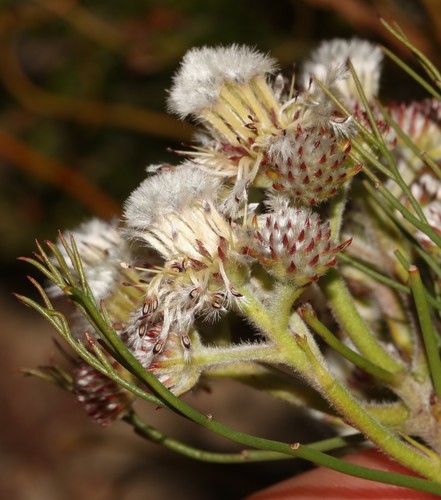
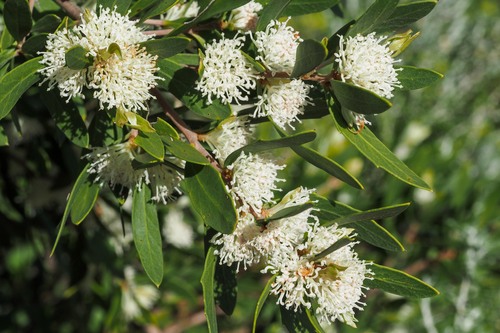
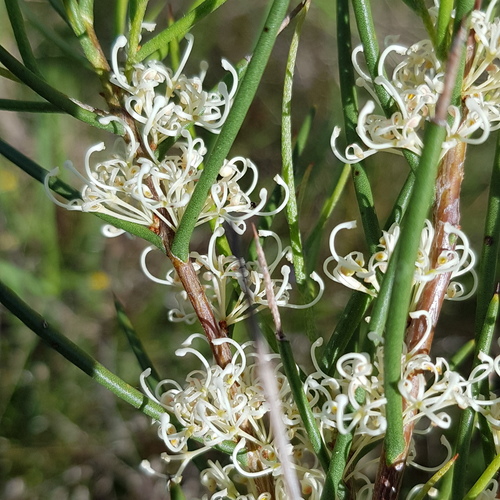
Hakea microcarpa, commonly called small-fruited hakea, is a shrub that reaches up to 2 meters (7 feet) in height, and it is often wider than it is tall. Its leaves and branches are hairless (glabrous), with the exception of a small number of hairs on new growth; these hairs are shed by the time the plant begins flowering. Most leaves are needle-shaped, measuring 3 to 11 centimeters (1 to 4 inches) long and approximately 1.5 millimeters (0.06 inches) wide. Occasionally, a few flat leaves that are up to 5 millimeters (0.2 inches) wide also develop. The off-white flowers are arranged in groups of 10 to 40, growing in leaf axils. Each individual flower has a stalk 2 to 5 millimeters (0.08 to 0.2 inches) long, and the perianth measures 2.5 to 3.5 millimeters (0.098 to 0.14 inches) long. Flowering occurs between September and February. After flowering, the plant produces a woody oblong follicle fruit that holds two winged seeds. The follicle is around 16 millimeters (0.6 inches) long and 7 millimeters (0.3 inches) wide, with a small 2 to 3 millimeter (0.08 to 0.1 inch) long point on each of its two sides. This species grows along the east coast and ranges of Australia, ranging from Stanthorpe to Tasmania. It inhabits subalpine bogs, or damp sites within forest or woodland environments.