About Hakea lissosperma R.Br.
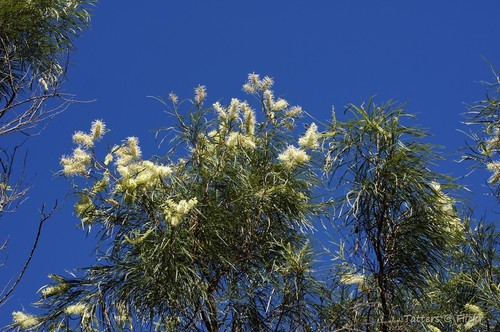
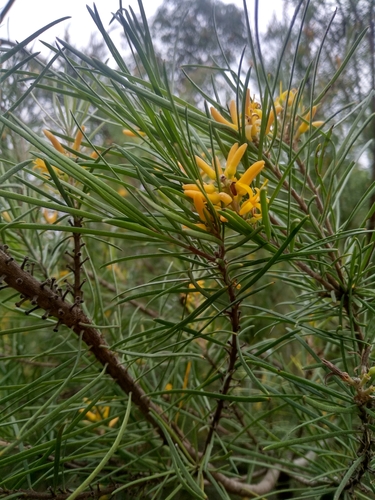
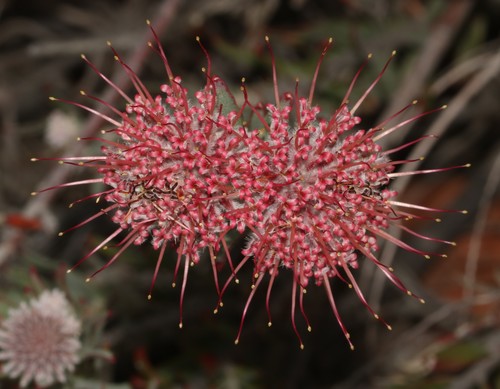
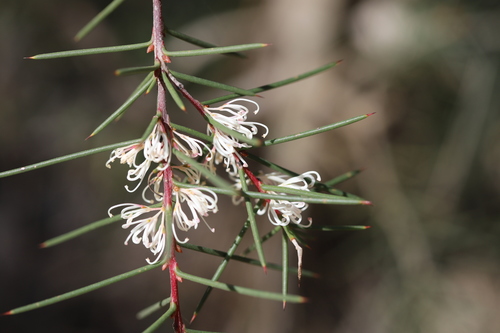
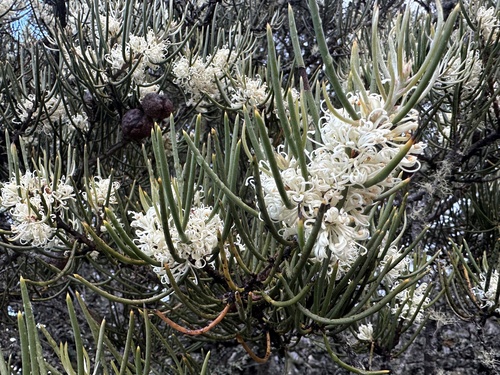
Hakea lissosperma R.Br., commonly known as mountain needlewood, is a spreading shrub or small tree that typically reaches 2 to 6 metres (7 to 20 feet) in height. It is a low woody plant with several main stout branches, and commonly has spiny leaves and dense clusters of white flowers. Its evergreen leaves are flat and terete, usually measuring 6 to 10 centimetres (2.4 to 3.9 inches) in length and 1.5 to 2 millimetres (0.059 to 0.079 inches) wide. Its leaf follicles are generally 20 to 30 mm (0.79 to 1.18 in) long and 15 to 20 mm (0.59 to 0.79 in) wide; mature follicles are about 2.3 to 2.7 cm (0.91 to 1.06 in) long and 1.7 to 2 cm (0.67 to 0.79 in) wide, with a coarsely wrinkled or blistered texture.
This species is distributed across Tasmania, Victoria, New South Wales, and the Australian Capital Territory in Australia. In Tasmania, it is commonly found in Break O'Day, Central Highlands, Circular Head, Derwent Valley, Dorset, Flinders Island, Glamorgan-Spring Bay, Hobart, Huon Valley, Kentish, Kingborough, Launceston, Meander Valley, Northern Midlands, Southern Midlands, Tasman, Waratah-Wynyard, and the West Coast. In Victoria, it occurs in eastern parts of the state, including East Gippsland, Fall Highlands, the Victorian Alps, and the Snowy Mountains. In New South Wales, it only grows in alpine areas in the southeast, surrounding the Australian Capital Territory.
Mountain needlewood is most commonly found in wet eucalypt forest, and is widespread from sea level up to 1,200 metres (3,937 ft) on mountains in high rainfall areas. It also occurs in dry forest habitat at altitudes of 700 m (2,297 ft) in parts of Victoria. This species is frost hardy and drought tolerant to suit its natural habitats. It prefers moist, shady sites and grows well in fertile loam soils, but cannot tolerate high levels of phosphorus.
For cultivation, this tree should only be planted in a sheltered location. Seeds can be collected at any time of year, but only from older, typically grey-brown fruit. Collected seeds must be leached; dry fruit will usually open within 2–3 weeks, or can be opened by placing it in an 80 to 100 °C (176 to 212 °F) oven for 30 minutes with the oven door partially open. In addition to leaching, stratification can also be used. After planting, germination takes approximately 6 months. The dense flower clusters and pungent rigid needle-shaped leaves of this species make it a favourite of birds, which can use the foliage as shelter from predators. It is also resistant to wildlife browsing because it is unpalatable.