About Hakea laurina R.Br.
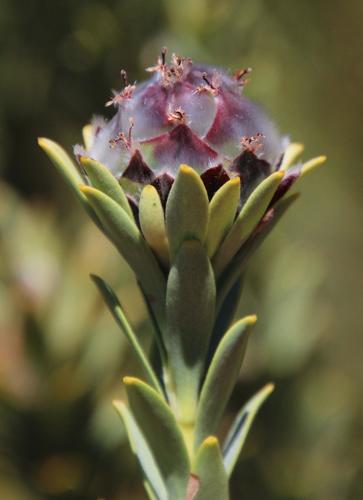
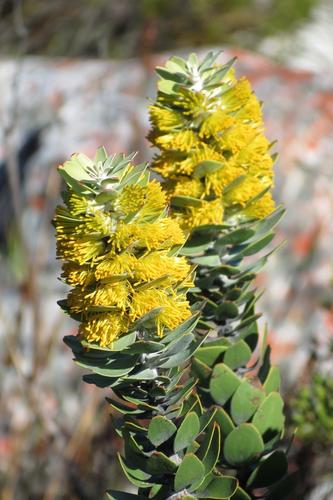
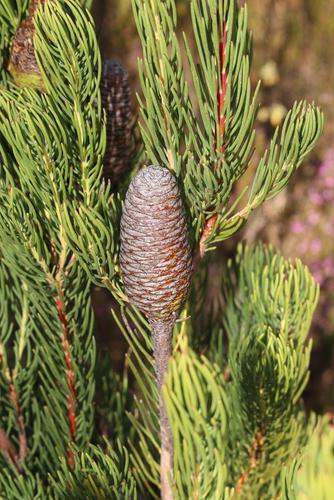
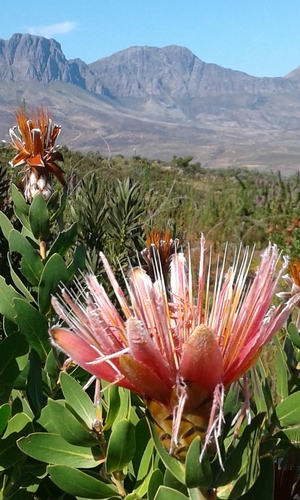
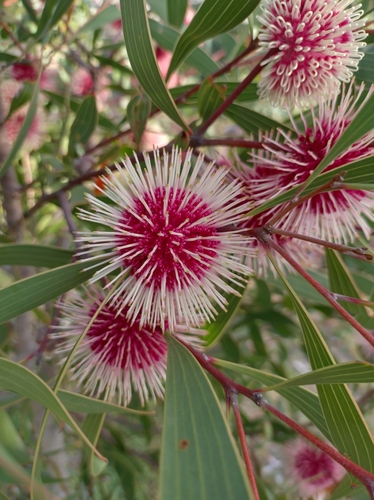
Hakea laurina (common name pincushion hakea) is an upright shrub or small tree that grows 2.5 to 6.0 meters tall, 3 to 5 meters wide, has smooth grey bark, and does not form a lignotuber. Its inflorescence holds 120 to 190 noticeable pin cushion-shaped flowers, which are white, deep pink or red, growing in leaf axils. The pedicels are 5.5 to 9.5 millimeters long and smooth. The perianth ranges from dark pink to red, while the 14 to 19.5 millimeter-long pistil is usually cream-white, occasionally red or dark pink. Unopened flower buds are enclosed in scale-like bracts, and flowering takes place from April to July. The simple leaves are slightly blue-green, flat, smooth, with smooth unbroken margins. They are lance or egg-shaped, tapering to a blunt point at the tip, arranged alternately along branches. Each leaf is 7 to 21 centimeters long, 6 to 29 millimeters wide, borne on a 1 to 2 centimeter-long stem, and narrows at its base. The fruit grows in clusters of 1 to 9 per axil, each fruit is 2.2 to 3.8 centimeters long, 1.6 to 2.3 centimeters wide, egg-shaped, smooth, occasionally with rough pitting, and ends in a short beak. Pincushion hakea is endemic to the coastal southwest of Western Australia. Its range extends north to Narrogin and east to Esperance, and it most commonly grows on sandplains, and sometimes on sandy clay. Most recorded specimens are found in the southern districts of its native botanical province. Introduced populations have been recorded on Kangaroo Island and in the Mount Lofty Ranges in South Australia. Propagated from seeds, this plant is cultivated in the eastern states of Australia, and grown as hedging or street planting in America and Italy. It adapts to a wide range of soil types and is tolerant of frost. Cultivated uses include ornamental planting and shading for public streets, providing wildlife habitat, acting as windbreaks, and controlling soil erosion.