About Hakea corymbosa R.Br.
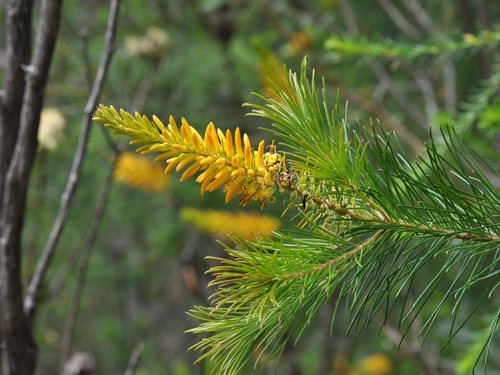
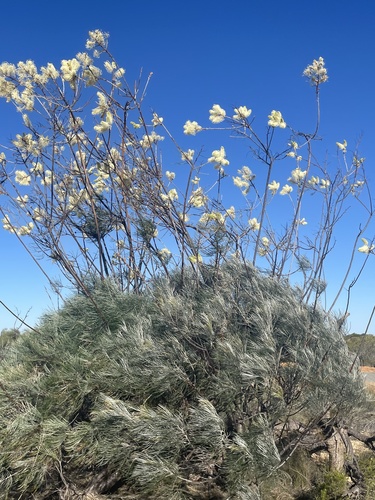
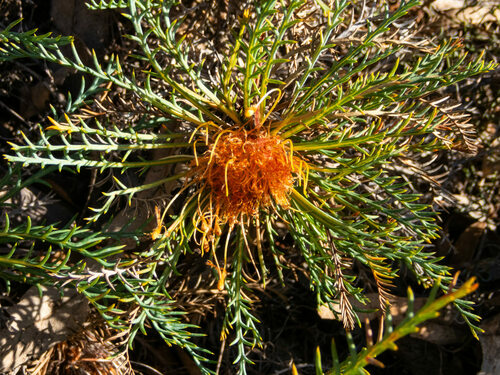
Hakea corymbosa R.Br. is a non-lignotuberous, erect, multi-branched shrub that grows 0.5 to 2 metres (1.6 to 6.6 ft) high and 2.5–3 m (8–10 ft) wide. Its young shoots are called "water canes", which develop into a new cluster of foliage when mature. Mature shrubs become extremely dense and prickly, with foliage that grows in clusters that look like "clouds".
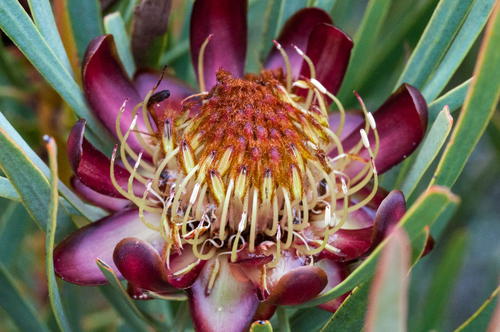
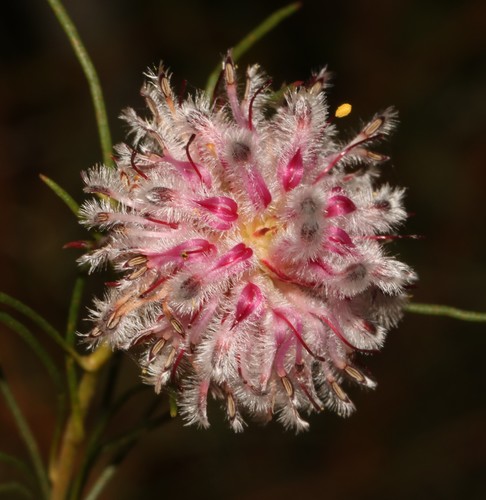
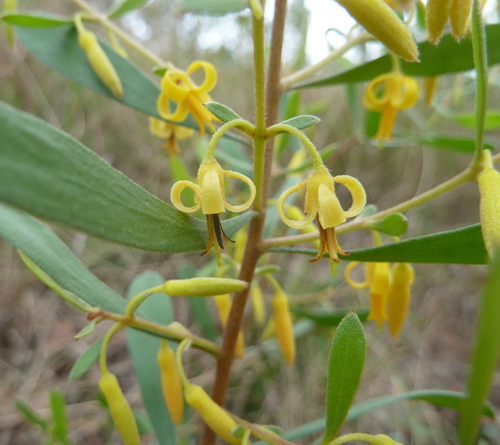
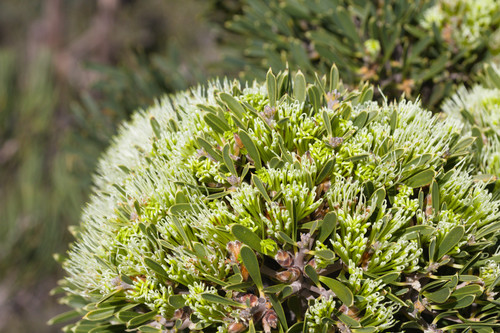
Narrow waxy leaves measure 2.5 to 12 cm (1.0 to 4.7 in) long and 0.2 to 0.8 cm (0.079 to 0.315 in) wide on lower parts of the plant, and are arranged in whorls near the flowers. Leaves are alternately arranged along stems, have one distinct central vein on the upper surface and three veins on the underside, and end in a sharp point. The inflorescence holds 12-18 abundant flowers that grow in leaf axils. The smooth pedicel is 3.5–5 mm (0.1–0.2 in) long, and the perianth is pale yellow-green. The woody fruit has a slightly rough texture, is broadly egg-shaped, 2 to 3 centimetres (0.8 to 1.2 in) long and 1.5 cm (0.59 in) wide, and ends in a short sharp point with no beak. Winged seeds measure 12–17 mm (0.47–0.67 in) long and 6.5–11 mm (0.26–0.43 in) wide.
This species is native to the Great Southern, southern Wheatbelt and Goldfields-Esperance regions of Western Australia, ranging from Williams in the west, Albany in the south to Kondinin in the north and Cape Arid in the east. It grows in acid to slightly alkaline sandy soils over or adjacent to laterite or granite, in heath or woodland habitats.
In horticulture, Hakea corymbosa can be grown in a sunny position in most soil types, and prefers temperate climates with annual rainfall over 400 mm (16 in). Plants grown in shady locations typically develop elongated growth. It can be cultivated as a windbreak, hedge, or for erosion control. It is recommended for attracting birds: its dense prickly growth provides a safe shelter, and its nectar-rich flowers act as a food source. Propagation is done by seed; seed collection is best done wearing gloves, due to the plant's prickly foliage.