About Hafferia zeledoni (Pelzeln, 1868)
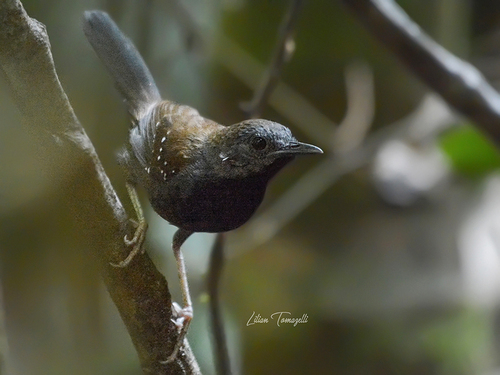
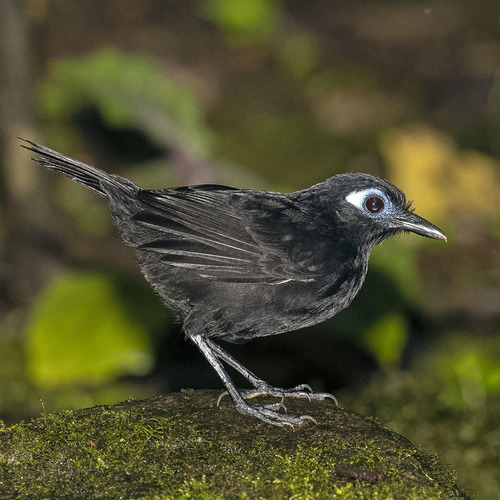
Zeledon's antbird, scientifically named Hafferia zeledoni (Pelzeln, 1868), is 17 to 20 cm (6.7 to 7.9 in) long and weighs approximately 40 to 56 g (1.4 to 2.0 oz). Individuals of both sexes have a wide pale blue ring around the eye and a deep red iris. Adult males of the nominate subspecies are mostly black, with variable amounts of white on the wing and wing coverts that is almost always hidden. Adult females are mostly dark brown, with underparts that are paler than their upperparts, and have black lores and face. Males of the subspecies H. z. berlepschi have more white on their wings than the nominate subspecies, while H. z. berlepschi females are a paler and brighter brown than nominate females. Immature males of both subspecies resemble adult females. Zeledon's antbird has a disjunct distribution. The nominate subspecies ranges from Río San Juan Department in far southern Nicaragua south through Costa Rica into Panama, reaching as far as Coclé Province. In Costa Rica, it occurs mostly on the Caribbean slope and is much less frequent on the Pacific slope. Subspecies H. z. berlepschi is found from eastern Darién Province in Panama, and continues south along the Pacific slope through Colombia to western Loja Province in southwestern Ecuador. This species inhabits the understorey and edges of humid evergreen forest and mature secondary forest in the foothills. It occurs mostly in regenerating landslides and tree-falls on steep hillsides and ravines. Its elevation range is between approximately 250 and 1,750 m (800 and 5,700 ft) in Central America; in Costa Rica it mostly occurs above 500 m (1,600 ft) on the Caribbean side and above 900 m (3,000 ft) on the Pacific side. In Colombia it occurs between 100 and 1,600 m (300 and 5,200 ft), and in Ecuador it mostly occurs below 1,400 m (4,600 ft) but locally reaches up to 2,000 m (6,600 ft).