About Haemulon scudderii Gill, 1862
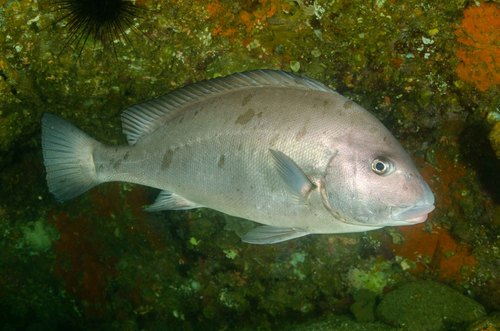
Haemulon scudderii Gill, 1862 has an oblong, compressed body with an oblique mouth that has a projecting lower jaw. Its lips are not fleshy, and the mouth opens below the center of the eye. It has a continuous dorsal fin with a small to medium-sized notch in its middle. The dorsal fin has 11 to 12 spines and 14 to 17 soft rays, while the anal fin has 3 spines and 7 to 8 soft rays.
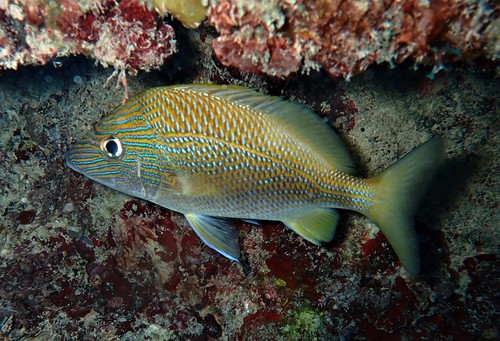
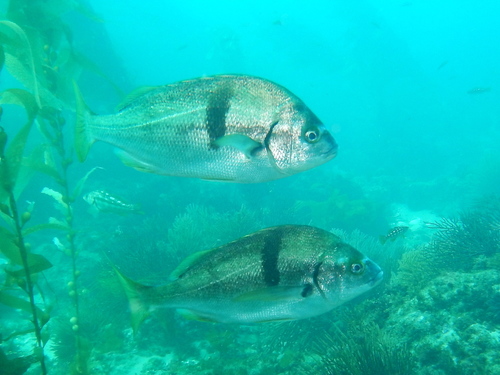
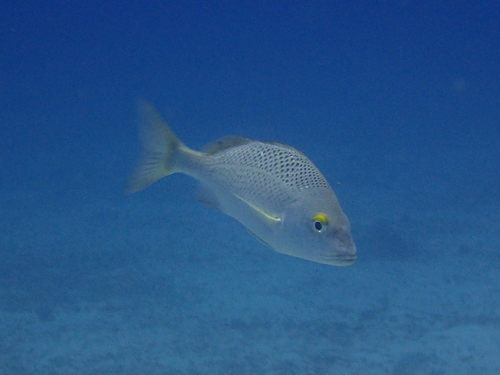
The overall body color of this species is silvery-grey, and each scale bears a black spot. It has notably golden eyes, and the inside of the mouth is normally orange. The median fins are black, and the pectoral and pelvic fins are a slightly lighter dusky color. Juveniles have a dark midlateral stripe that connects to a black spot at the base of the caudal fin, plus a second stripe that runs from the upper part of the eye to the upper surface of the caudal peduncle. This species reaches a maximum total length of 35 cm (14 in), with 30 cm (12 in) being a more typical size.
Haemulon scudderii is endemic to the eastern Pacific Ocean. Its range extends from southern Baja California and the central Gulf of California south along the coasts of Central America and South America as far south as Ecuador, and includes the Galapagos Islands.
This species occurs at depths between 1 and 30 m (3 ft 3 in and 98 ft 5 in), where it forms shoals around rock reefs in inshore waters with some tidal movement. It is a nocturnal carnivore that preys on benthic invertebrates including crustaceans, echinoderms, and molluscs, as well as small fish. Haemulon scudderii is a poorly studied species with little known about its overall biology, though it is confirmed to be oviparous, and spawning occurs in distinct pairs.