About Haemulon sciurus (Shaw, 1803)
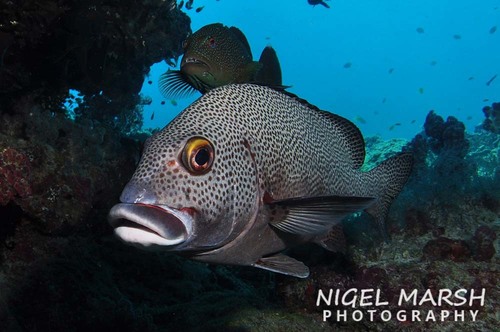
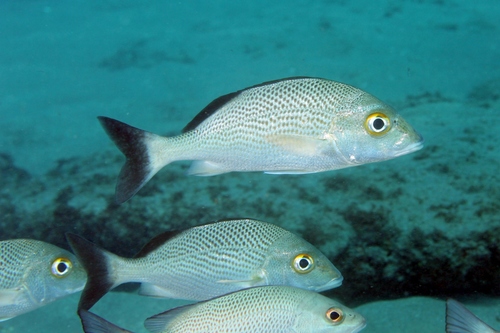
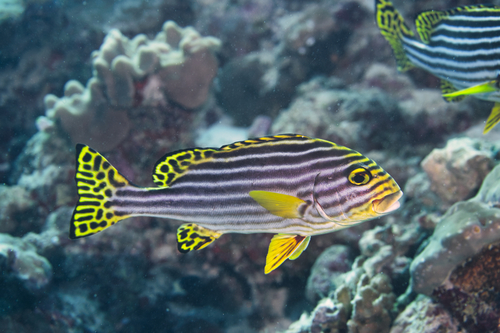
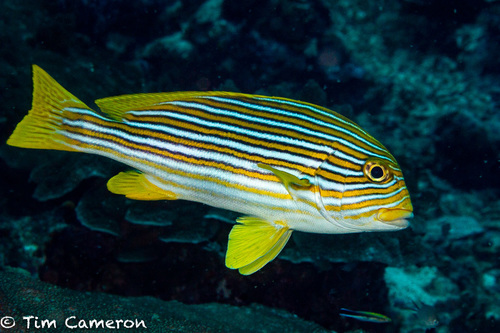
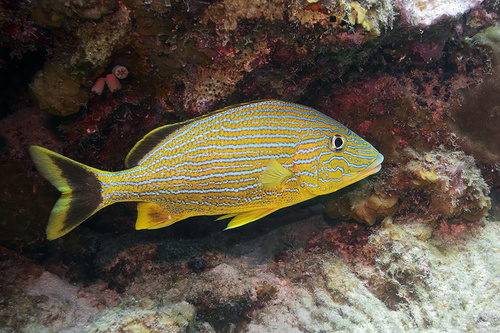
The bluestriped grunt, Haemulon sciurus, has a deep, almond-shaped body with a moderately convex dorsal profile. Its upper jaw reaches the area beneath the center of the eye. Scales above the lateral line are enlarged, while scales below the lateral line are arranged in a diagonal pattern. It has a continuous dorsal fin with a small to medium notch at its center. The dorsal fin holds 12 spines and 16 to 17 soft rays, and the anal fin holds 3 spines and 9 soft rays. The head and body have an overall yellow base color broken up by thin, longitudinal blue stripes, with a distinctively arched stripe located below each eye. The spiny portion of the dorsal fin is yellow; the soft-rayed portion of the dorsal fin and the caudal fin are dark; the anal fin is sooty yellow; and the pelvic and pectoral fins are whitish. The inside of the mouth is bright vivid red. Small juveniles under 22 mm (0.87 in) long have clearly visible melanophores on their caudal peduncles. As the fish grows, these melanophores also grow, forming a dark stripe that starts just behind the eye and runs to the caudal peduncle. Once juveniles reach 50 mm (2.0 in) in length, they develop the adult colouration. This species reaches a maximum total length of 46 cm (18 in), with a more typical adult length of 25 cm (9.8 in). The bluestriped grunt is distributed in the western Atlantic Ocean. Its range extends from South Carolina and Bermuda south along the United States coast to the Bahamas. In the Gulf of Mexico, it occurs from the Florida Keys north to Cedar Key, and from Tuxpan, Mexico along the northern coasts of the Yucatan Peninsula to northwestern Cuba. It can also be found throughout the entire Caribbean Sea. The bluestriped grunt lives in shallow water at depths from 1 to 40 m (3 ft 3 in to 131 ft 3 in). It is commonly found in mangroves, reefs, and sea grass beds. Adult bluestriped grunts form small schools that gather over coral and rocky beds, particularly near drop-offs. Juveniles are very common in shallow water turtle grass (Thalassia testudinum) beds. They forage for smaller fish, crustaceans, and bivalves in sea grass beds and mangroves. Foraging happens at night, and the fish rest in rocky areas during the day. Little is known about the spawning behaviour of the bluestriped grunt, but spawning has been recorded between January and April in the Caribbean Sea. When larvae grow into juveniles, they settle into sea-grass beds once they reach lengths between 9 and 17 mm (0.35 to 0.67 in). Bluestriped grunts often interact by pushing one another backwards in open-mouthed, head-on contests, and they produce a characteristic grunting noise using their pharyngeal teeth. They are preyed on by larger fish including sharks and groupers, and one documented parasite of this species is the monogenean Encotyllabe spari.