About Haemulon plumierii (Lacepède, 1801)
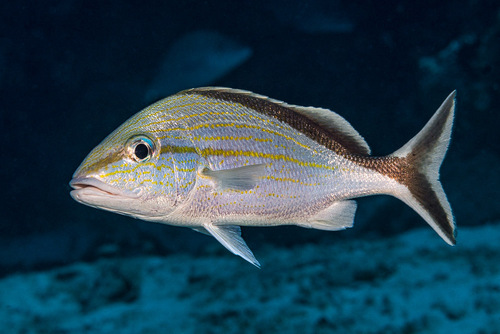
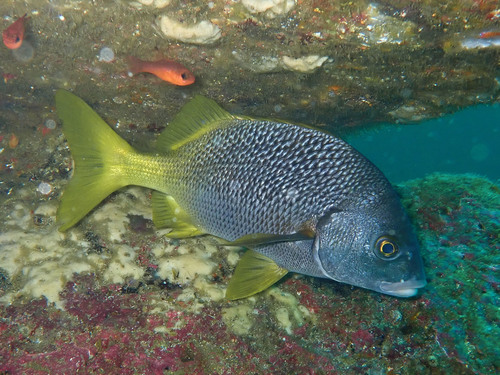
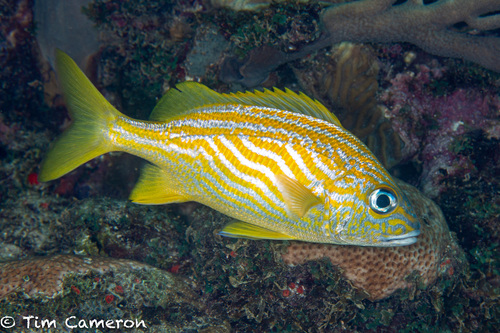
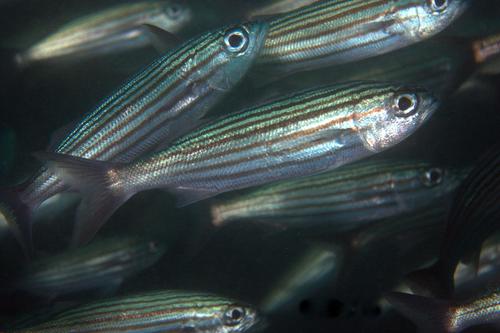
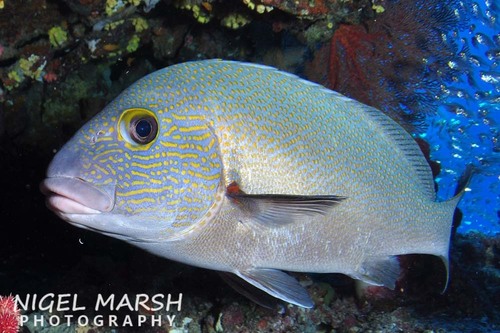
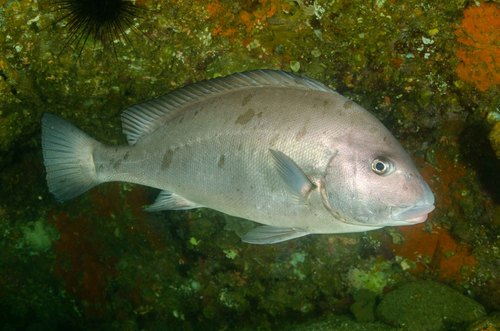
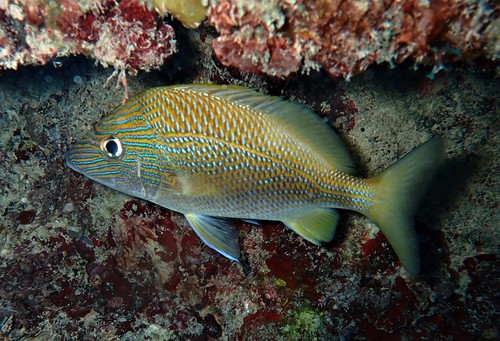
The white grunt, scientifically named Haemulon plumierii (Lacepède, 1801), has a silvery cream body marked with many yellow and blue horizontal stripes. It has a long head with a distinct snout, falcate pectoral fins, a forked caudal tail, numerous dorsal spines, and rough teeth. Unlike groupers or snappers, grunts have a strong fixed lower jawbone. The average length of this fish is 6 to 12 inches, and it often changes its color to match its immediate surroundings, becoming paler or darker to match. White grunts have been recorded reaching lengths over 20 inches and weights over 15 pounds. White grunts live near mangroves, reefs, docks, and almost any type of structure within their range, which covers the Western Atlantic from Chesapeake Bay through the Caribbean and Gulf of Mexico, extending south to Brazil. It typically lives at depths from 0 to 30 meters, similar to its relative the bluestriped grunt. This species is closely related to the bluestriped grunt (H. sciurus) and the French grunt (H. flavolineatum), and is often found schooling with these two species. The characteristic "grunt" sound this fish produces comes from grinding its pharyngeal teeth at the back of the throat. This sound is usually made when the fish is distressed or in danger, such as when it is caught by an angler. On a commercial scale, the white grunt has minor importance, but it is fairly popular as a game fish for children, beginners, and even experienced fishermen. Grunts are easy to catch and have white meat that cooks well, so they are sometimes caught for food. A historic Florida dish, "grits and grunts", is traditionally made with H. plumierii. White grunts are also used as bait for large piscivorous fish, and they are highly valued as aquarium fish because of their bright colors.