About Haemulon flavolineatum (Desmarest, 1823)
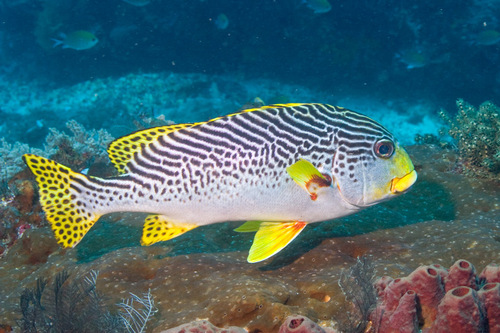
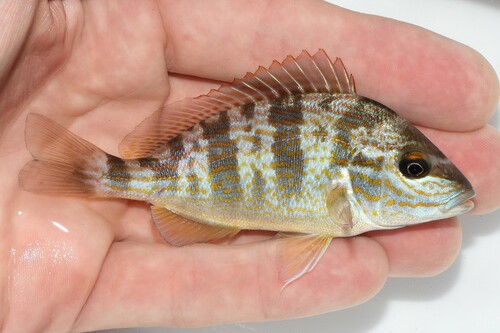
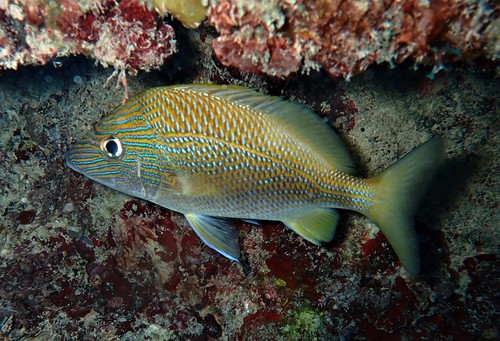
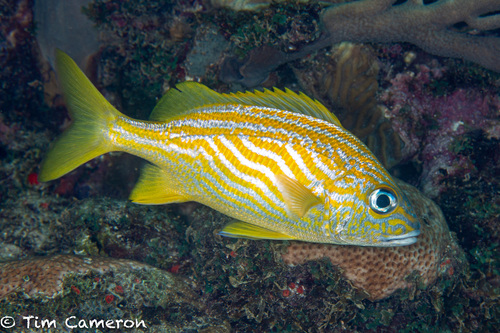
Haemulon flavolineatum (Desmarest, 1823) has a compressed, almond-shaped body ending in a blunt snout. Its small to medium-sized mouth has thick lips and narrow bands of teeth on each jaw, with the outer row of teeth being conical; there are no teeth on the roof of the mouth. This species has a continuous dorsal fin with a small to medium notch, containing 12 spines and 14 to 15 soft rays. The anal fin contains 3 spines and 8 soft rays. The fish's background body colour ranges from whitish to bluish or yellowish. There are three bright yellow to orange horizontal stripes above the lateral line, and a number of similarly coloured oblique stripes below the lateral line. Yellow spots mark the lower surface of the head, the inside of the mouth is red, the fins are yellow, and the abdomen is white. This species reaches a maximum total length of 30 cm (12 in), with 17 cm (6.7 in) being a more typical size. H. flavolineatum is distributed in the western Atlantic Ocean. Its range extends from South Carolina and Bermuda in the north, along the United States coast to the Bahamas, into the southern Gulf of Mexico including the Florida Keys. It is also found from Tuxpan, Mexico eastwards along the northern coast of the Yucatan Peninsula to northwestern Cuba, and south into the Caribbean Sea as far as Trinidad. H. flavolineatum occurs at depths between 1 and 60 m, over rocky areas and coral reefs, where it can form large aggregations of thousands of individuals. Individual fish may stay under ledges or near elkhorn coral. Juveniles are often found in large numbers sheltering in seagrass beds in protected bays, lagoons, and other coastal waters. This species is mainly nocturnal, emerging at night to forage over sand flats and in seagrass beds to feed on benthic invertebrates including molluscs, crustaceans, and polychaetes. H. flavolineatum has pelagic eggs and larvae, though little is known about its reproductive habits. Larvae remain in this life stage for 2 weeks before settling into seagrass. H. flavolineatum is an abundant species across its range. It is caught with traps and seines, but catches of this species are not recorded separately. The flesh is typically sold fresh. Off Barbados, it is one of the most common species caught in local fisheries. It is rare in the private aquarium trade, but is more commonly kept in public aquarium displays.