About Haemulon chrysargyreum Günther, 1859
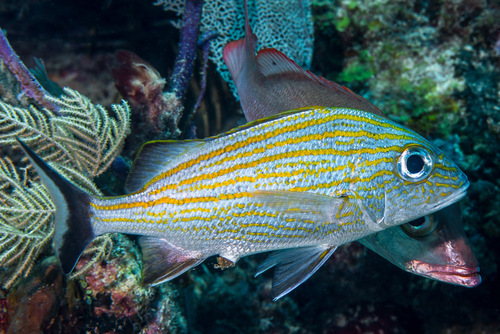
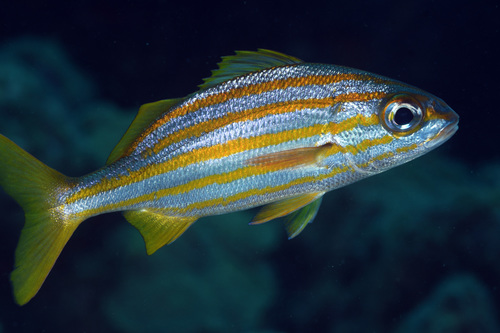
Haemulon chrysargyreum Günther, 1859 (originally referenced as B. chrysargyrea) is a small fish species that reaches a maximum total length of 23 cm (9.1 in), with a typical adult length of 17 cm (6.7 in). This fish has a short snout and a small, almost horizontal mouth; its jaws normally do not extend as far back as the front margin of the pupil. The inside of its mouth is red. It has a laterally compressed body and a forked caudal fin. Its base body color is silver, marked with five bronze-yellow horizontal lines along its sides. All fins except the pectoral fins are partially or fully yellow. The dorsal fin has 12 spines and 13 soft rays, while the anal fin has 3 spines and between 9 and 10 soft rays. This species is widespread across the western Atlantic Ocean, ranging from southern Florida to the coast of Brazil, and it is also found in the Gulf of Mexico and the Caribbean Sea. Adult individuals live on exposed sections of coral reefs and rocky coasts, at depths of up to 25 m (82 ft). Juveniles favor hard substrates, and are most often found around coral reefs or in Thalassia seagrass beds. This fish is most commonly caught as bycatch in fishing traps, and captured individuals are sold fresh for consumption. It is uncommon in the private aquarium trade, but it is found more frequently in displays at public aquariums.