About Haemulon carbonarium Poey, 1860
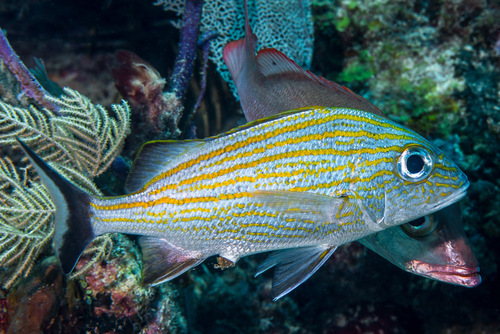
Haemulon carbonarium, commonly called the Caesar grunt, has an oblong, compressed body with a deep, blunt-snouted head. Its moderately sized mouth is horizontal and does not have very fleshy lips. It has a continuous dorsal fin with a slight notch at its center. The base of the soft-rayed portion of the dorsal fin and the entire base of the anal fin are covered in scales. The dorsal fin contains 12 spines and 15 to 16 soft rays, while the anal fin has three spines and eight soft rays. The overall body color is silvery white, marked with longitudinal orange-brown stripes that are broader and more visible above the lateral line. A characteristic black spot at the base of the caudal fin identifies this species. The anal, pectoral, and pelvic fins are transparent, and the caudal fin is dark. The dorsal fin is also transparent, with an orange-brown margin along its spiny portion and a dark margin along its soft-rayed portion. The head is marked with bronze-yellow stripes and spots, and the flesh on the inside of the mouth is orange. This species reaches a maximum total length of 36 cm (14 in), though 20 cm (7.9 in) is more common. The Caesar grunt is native to the western Atlantic Ocean. Its distribution ranges from Cape Canaveral, Florida and Bermuda in the north, southward through the Bahamas to the Gulf of Mexico, including the Florida Keys and Florida Middle Grounds. It is also found along the mainland coast from Tuxpan, Mexico along the northern coast of the Yucatan Peninsula to northwestern Cuba, and throughout the Caribbean Sea. Reports of this species from Brazil are likely misidentifications. Caesar grunts occur at depths between 2 and 30 m (6 ft 7 in to 98 ft 5 in). They live in clear water on rocky or coral reefs and in mangrove habitats. This is a social fish that forms schools, and feeds nocturnally on benthic invertebrates including crabs, gastropods, starfish, and polychaetes. Caesar grunts are oviparous; they form distinct mating pairs to spawn and produce pelagic larvae. The Caesar grunt is targeted by commercial fisheries in some parts of its range, and is also caught for the aquarium trade. It is caught using traps, hook-and-line gear, and seines, but catch statistics are not collected for this species. Captured individuals are mainly sold fresh.