About Haemulon album Cuvier, 1830
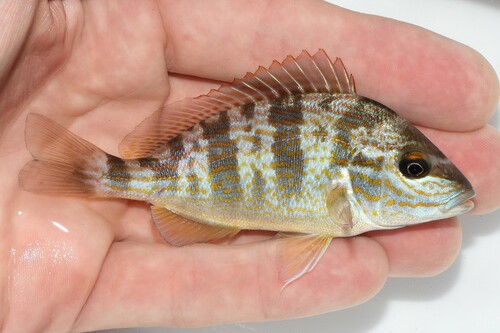
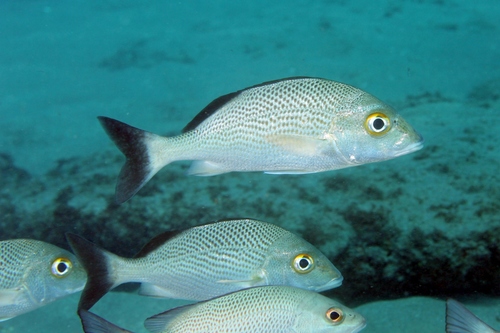
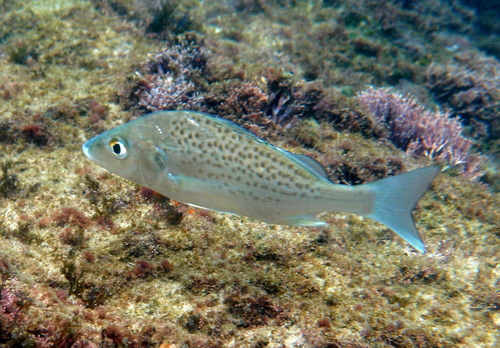
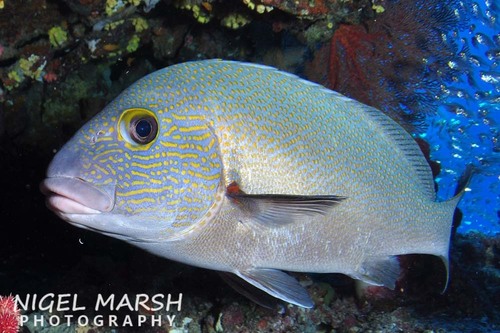
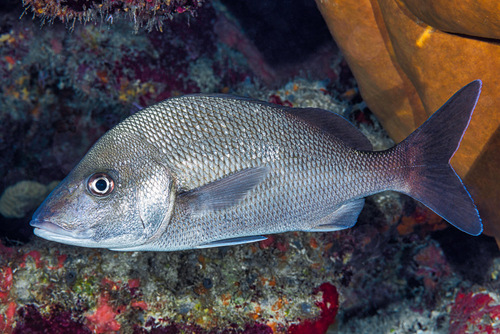
Haemulon album Cuvier, 1830, commonly called the white margate, has a high-backed, deep, oblong, compressed body with a blunt snout and small eyes. Its mouth is not very large, and its lips are not fleshy. This species has teeth on the pharynx and serrated gill covers. The rows of scales located just below the lateral line are angled. It has a continuous dorsal fin, with only a slight notch between the spiny and soft-rayed sections. The dorsal fin holds 12 spines and 15-17 soft rays, while the anal fin holds 3 spines and 7-8 soft rays. This species reaches a maximum total length of 70 cm (28 in), with 50 cm (20 in) being more typical. The body colour of the white margate ranges from greyish silver to light olive green, and this darker colour is usually limited to the back. The scales on the upper part of the body have dark spots. The soft-rayed part of the dorsal fin and the caudal fin are dark grey, while the other fins are pale. An indistinct dark blotch may appear on the gill covers. The lips and snout have a yellow hue, the inside of the mouth is orange, and the iris is white. Juveniles are bluish, marked with dark stripes on their ventral side. Subadults may also have some blackish colouration on their back, between the base of the dorsal fin and the tail. Haemulon album is found in the western Atlantic Ocean. Its range extends north to Bermuda and eastern Florida, and continues through the Bahamas, the Gulf of Mexico, and the Caribbean Sea. It occurs along the coast of Central America from Quintana Roo to islands and cays off Nicaragua. This species has also been confirmed in the waters around the Brazilian oceanic islands of Fernando de Noronha and Atol das Rocas, though it is not found on the mainland Brazilian coast. Haemulon album lives at depths between 2 and 60 m (6 ft 7 in and 196 ft 10 in) in clear tropical waters around coral reefs, rocky areas, shipwrecks, and seagrass beds. Juveniles prefer to stay near seagrass beds. This species is typically found as pairs or in large schools. It is a nocturnal feeder, and its diet consists mainly of benthic invertebrates, including recorded feeding on peanut worms and heart urchins, which it finds by nosing into the substrate. It also commonly feeds on bivalves, crustaceans, and small fishes. Females can spawn multiple times per season; off Jamaica, spawning occurs in spring and autumn. Spawning aggregations have been recorded off Belize. Haemulon album is targeted by commercial fisheries across its entire range. It is caught using traps, hook-and-line, and gill nets, and no catch data is collected for this species. Its flesh is sold fresh, and is marketed as "silver snapper" in some markets.