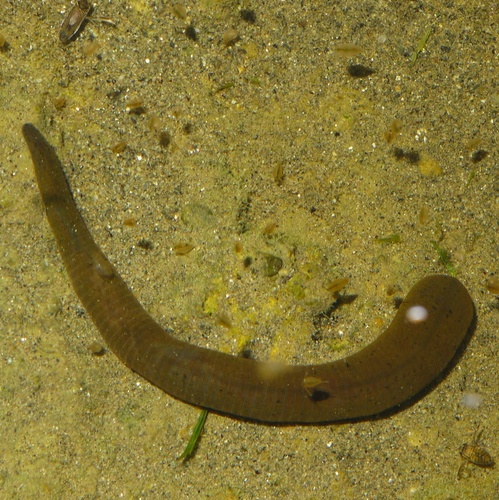
About Haemopis sanguisuga (Linnaeus, 1758)
Haemopis sanguisuga (Linnaeus, 1758) can reach a resting length of 10 cm (4 in), a size similar to the medicinal leech Hirudo medicinalis, but can extend to a longer length when stretched out. Its body is segmented; the dorsal (upper) surface is brownish-black, usually solid in color but sometimes marked with streaks and spots, while the ventral (under) surface is yellowish-grey or olive. It has two suckers: a small one at the anterior (front) end, and a larger one at the posterior (rear) end. A crescent-shaped grouping of five pairs of eyes sits on its head. Haemopis sanguisuga is a freshwater leech found across most of Europe and in Asia. Its typical habitats are shallow areas of lakes, ponds, ditches and slow-moving rivers. It can emerge onto land to hide under stones, can be found as far as 30 metres away from water, and tolerates slightly brackish water. Haemopis sanguisuga moves by looping: it attaches its front sucker to the substrate, draws its back sucker forward to position it close to the front sucker, then detaches the front sucker and extends its front end forward. It can also move by swimming. It has a few blunt teeth arranged in two rows, and is a predator rather than a blood-feeding species. It feeds on insect larvae, fish eggs and fry, tadpoles, worms, other leeches, and gastropods; prey is sucked in and swallowed whole. This leech sometimes leaves the water to hunt for earthworms. Like all other leeches, Haemopis sanguisuga is a hermaphrodite. In this species, testes mature first, and ovaries mature later in the organism's life. A pair of leeches will align with their clitellar regions in contact, and sperm is passed from the individual acting as a male to the female gonopore. Some time after mating, the female lays several eggs. These eggs are wrapped in an albumin-filled cocoon, which is secreted by the clitellum. The cocoon is buried in damp earth near the water's edge. When the eggs hatch, emerging juveniles are about 15 mm (0.6 in) in length. A parasitic diplomonad, Hexamita gigas, is sometimes found in the gut of this leech. Most species in the Hexamita genus infect vertebrates; the only other known invertebrate hosts for this genus of flagellates are cockroaches, such as the oriental cockroach (Blatta orientalis).

