About Haematopus unicolor J.R.Forster, 1844
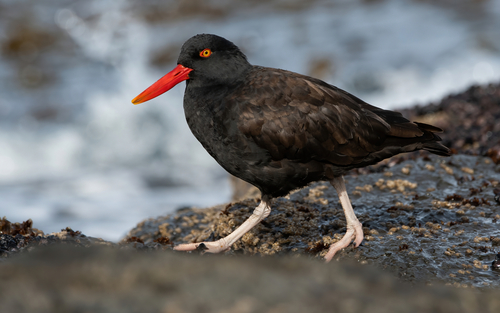
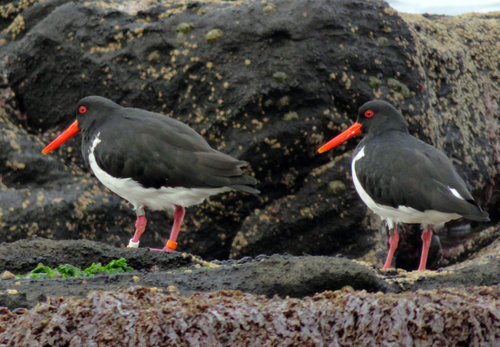
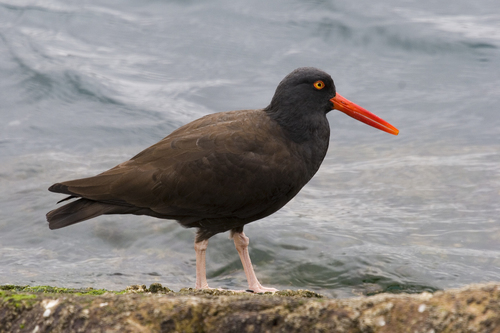
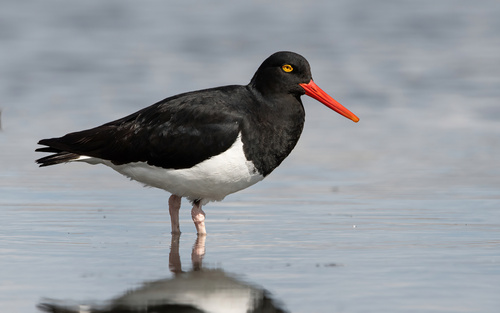
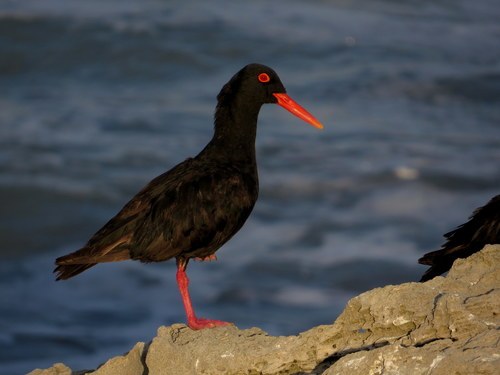
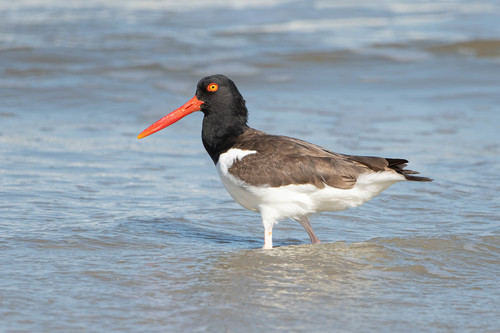
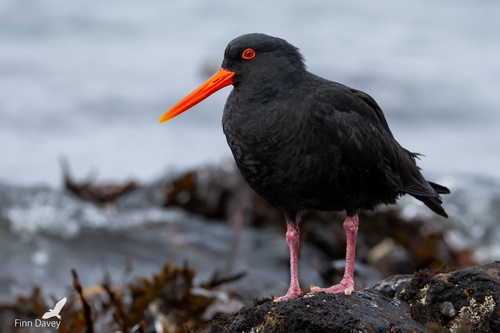
The name "variable" in Haematopus unicolor (variable oystercatcher) refers to its frontal plumage, which ranges from pied through mottled to entirely black. This species is polymorphic, meaning it has different genetic variants. These plumage color differences are linked to the latitude of the bird's habitat: the northernmost variable oystercatchers have significantly more white on their bodies than individuals from southern regions, and all variable oystercatchers on Stewart Island are all black. Variable oystercatchers have pink legs, an orange eye ring, and orange-red beaks. Their bill is thin and long, shaped like a needle, and darkens to a deep red during the breeding season. On average, males weigh around 678 grams, while females are slightly larger at around 724 grams. Individual birds measure 42 to 47 cm from beak to tail, and have a short, sturdy body with a thick neck. Variable oystercatchers can be distinguished from the South Island pied oystercatcher (SIPO), which weighs around 550 grams, by their slightly larger size. While variable oystercatchers are occasionally completely black, pied (black and white) individuals can easily be confused with SIPO. Unlike SIPO, the variable oystercatcher has less clear definition between black and white plumage areas, and a mottled band on the leading edges of its underwing. It also has a smaller white rump patch that only forms a band across the base of the tail, whereas the SIPO's white rump is a wide wedge shape that reaches up to the middle of the back. Mottled variable oystercatchers are sometimes called "smudgies". Although both sexes share the same range of plumage colorations and look visually similar, the species shows slight body size dimorphism, with females tending to be slightly larger. Haematopus unicolor is endemic to New Zealand. It has likely remained endemic due to its sedentary, non-migratory lifestyle that keeps all its populations within New Zealand's island habitats. The species is most often seen in pairs along the coast all around New Zealand, and occurs along most coastlines of the North Island, South Island, Stewart Island, and some nearby offshore islands, with the exception of outlying islands off the west coast. While it occurs in lower densities on western coastlines, it is concentrated in Northland, Coromandel Peninsula, Bay of Plenty, Greater Wellington, Nelson/Marlborough, and Fiordland. The species occupies a wide range of coastal habitat types that vary based on activity and available habitat, and is generally never found more than 30 km from the coast. It breeds and nests on sandy coasts, usually far from muddy harbours. Individuals sometimes gather in short-grassed paddocks and may forage in pastures after rain, but generally stay around coastal beaches, estuaries, and shorelines. It prefers sandy coastal areas and avoids gravel beaches and boulder-strewn areas. It nests on the shore between rocks or on sand dunes by scraping out a depression in sand or shingle, and sometimes lines this scrape with seaweed.