About Haematopus palliatus Temminck, 1820
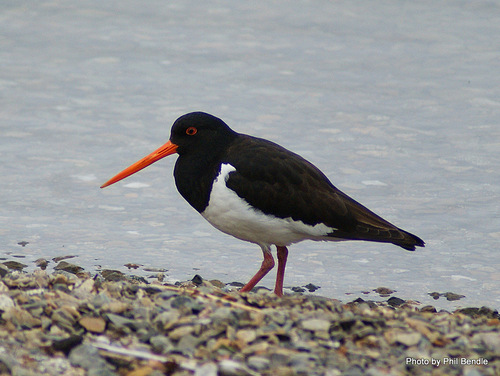
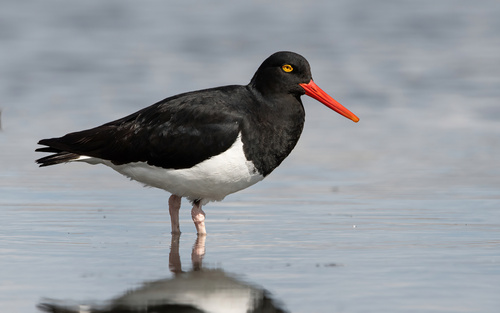
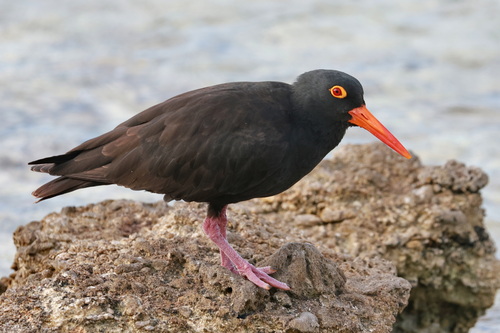
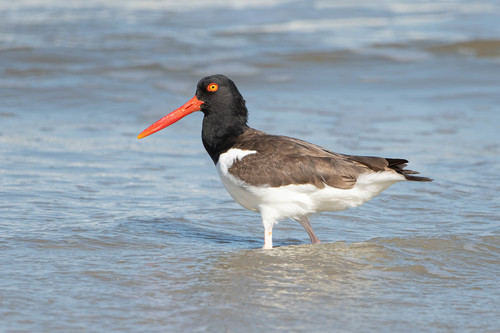
Description: The American oystercatcher (Haematopus palliatus Temminck, 1820) has distinctive black and white plumage, paired with a long, bright orange beak. Its head and breast are black, while its back, wings, and tail are greyish-black. Its underparts are white, as are the feathers on the inner part of its wing that become visible during flight. It has yellow irises, orange orbital rings around its eyes, and pink legs. Adult American oystercatchers measure between 42–52 cm (17–20 inches) in length.
Distribution: This species occurs on the Atlantic coast of North America from coastal Massachusetts to northern Florida, and can also be found on the Gulf coast, in the Caribbean, and extends south to Brazil, Uruguay, and Argentina. It is also present on the Pacific coast of California, Mexico, Central America, Peru, and Chile. In the 19th century, the species became locally extinct in the lower northeastern United States as a result of market hunting and egg collecting. After it gained protection under the Migratory Bird Treaty Act, its range expanded northward and it re-occupied historical habitat in the coastal Northeast. During the breeding season, American oystercatchers are found along the Atlantic and Gulf Coasts, and from Massachusetts south to Argentina and Chile. In winter, they gather in flocks along the coast from central New Jersey to the Gulf of Mexico.
Habitat: During the breeding season, the American oystercatcher inhabits coastal habitats that include sand or shell beaches, dunes, salt marshes, marsh islands, mudflats, and dredge spoil islands made of sand or gravel. During migration and winter, they feed on mud or salt flats that are exposed by the tide, and can also be found on shellfish beaches during these seasons.