About Haematopus moquini Bonaparte, 1856
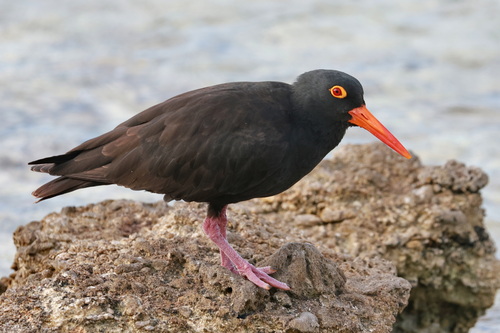
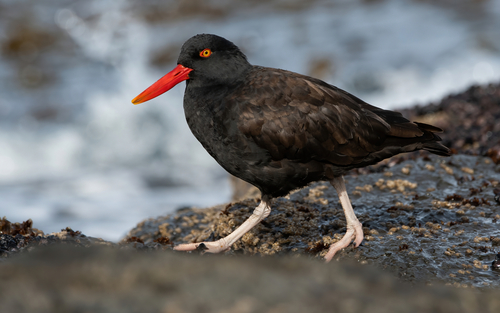
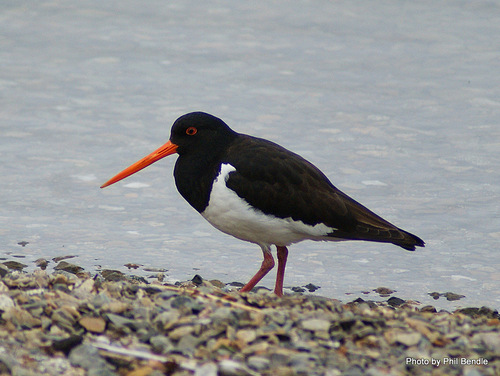
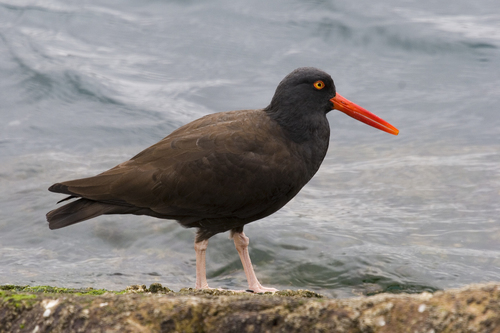
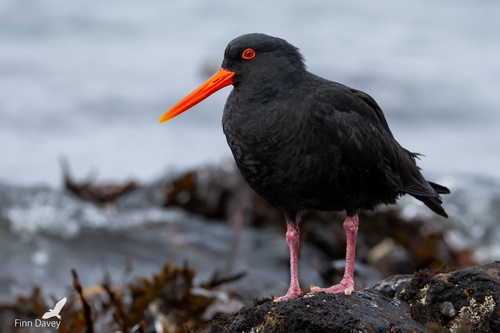
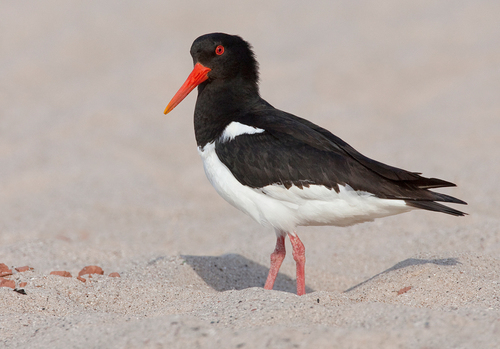
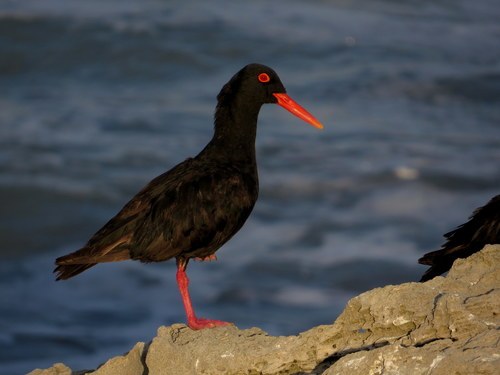
The African oystercatcher (scientific name Haematopus moquini Bonaparte, 1856) is a large, noisy wading bird. Adults have entirely black plumage, red legs, and a strong, broad red bill. Males and females look similar, but females are larger and have a slightly longer beak than males. Juveniles have soft grey plumage, and do not develop the species' characteristic red legs and beak until after they fledge. The species' call is a distinctive loud piping, very similar to the call of Eurasian oystercatchers. Eurasian oystercatchers are migratory, and only occur as vagrants in southern Africa. Their black-and-white plumage means there is no chance of confusing the two species.
This oystercatcher is native to the mainland coasts and offshore islands of Southern Africa. Its breeding range stretches from Lüderitz, Namibia to Mazeppa Bay in the Eastern Cape of South Africa. In winter, individuals disperse north as far as southern Angola and southern Mozambique. The total adult population is estimated to be over 6,000 birds. There is a single vagrant record from Gambia: a 1938 specimen held at the British Museum that was originally considered unidentified or possibly a Canary Islands oystercatcher (H. meadewaldoi), but genetic analysis later confirmed it as H. moquini. African oystercatchers are typically sedentary, and rarely leave their territories, which cover both a nesting site and feeding grounds. These territories are usually located on or near rocky shores, where the birds feed.