About Haemanthus coccineus L.
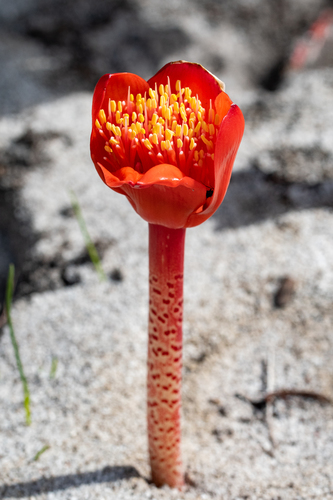
The flowerheads of Haemanthus coccineus emerge between February and April, with 6 to 9 stiff red spathe valves surrounding 25 to 100 individual flowers. Translucent, fleshy berries ranging in color from white to red develop shortly after flowering finishes. Each bulb typically produces two large leaves, and occasionally three, which grow after the plant has finished blooming. The leaves are elliptic to broadly shaped, measuring 25 to 210 millimetres wide. Their undersides are most often more-or-less barred with red or dark green, and leaves may grow prostrate, recurved, or suberect. Its striking, brilliant flowerheads led to its early introduction to European cultivation; Carl Linnaeus formally described the species in 1762. Along with Haemanthus sanguineus (Jacq.), this species was the first Haemanthus introduced to European horticulture as an ornamental plant. In cultivation in the United Kingdom, H. coccineus has received the Royal Horticultural Society's Award of Garden Merit. It can be grown outdoors in the UK in warm, frost-free, sheltered, south-facing locations. Despite Linnaeus's 1762 description, this single species was originally published under many different names. This historical taxonomic confusion reflects past organizational disarray in the genus, rather than actual high variability within the species. The plant shown on the left was first described as Haemanthus hyalocarpus by Jacquin in 1804, and all individuals featured in the accompanying gallery are H. coccineus, originally described under the names given in their captions. Haemanthus coccineus is widespread across the winter rainfall region of Southern Africa. Its distribution extends from southern Namibia, through the Cape Peninsula of South Africa, to the Keiskamma River in the Eastern Cape. It grows naturally in Renosterveld and Fynbos habitats. It is a highly adaptable species that can grow in a wide range of soils derived from sandstones, quartzites, granites, shales, and limestones. It tolerates annual rainfall levels between 100 and 1,100 millimetres (3.9 to 43.3 inches). It also adapts to a broad range of altitudes, growing from coastal dunes up to 1,200-metre (3,900-foot) high mountains. It is hardy to approximately 1 °C (34 °F), but cannot survive extended exposure to freezing temperatures. It is often found growing in large clumps of hundreds of individuals, growing under the shelter of other shrubs on flat land, or in shady ravines and rock crevices.