About Hadrurus arizonensis Ewing, 1928
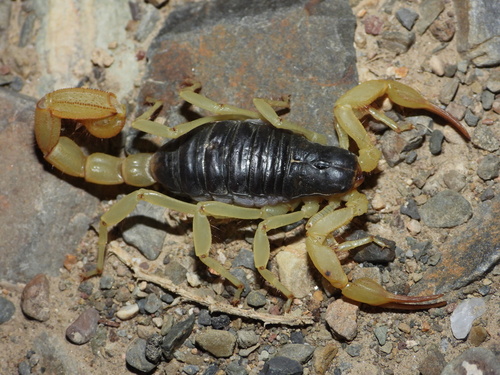
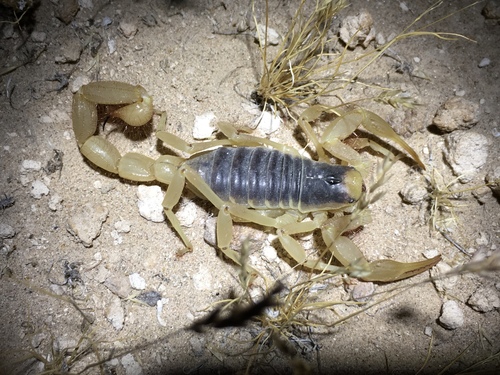
Hadrurus arizonensis is the largest scorpion found in North America, and it is one of 8 to 9 species of the Hadrurus genus present in the United States. It reaches a length of 14 cm (5.5 in), and total body length can also range from 10 to 18 cm, with an average length of 15 cm. Individuals weigh 4 to 7 g, with an average weight of 5 g. Males and females are very similar in overall appearance, and they are usually tan to olive-green in color, with a darker back and yellow pedipalps, legs, and tail. This species can also be usually yellow with a dark top, and has crab-like pincers. It gets its common names from the brown hairs that cover its body, and these hairs help it detect vibrations in the soil. Females of the species tend to have wider, stockier bodies, while males tend to have larger pincers. Hadrurus spadix is a closely similar species.
This species is distributed throughout the Sonoran and Mojave deserts. In Mexico, its range flanks the Gulf of California in Sonora and Baja California. In the United States, it occurs in the western two-thirds of Arizona, the Colorado Desert and Mojave Desert regions of southern California, southern Nevada, and extreme southwestern Utah. It commonly occupies abandoned burrows, small caves, and crevices. It also seeks out ornamental plants and irrigated lawns that attract beetles and other invertebrate prey, and generally lives at elevations between 900 and 1800 m. Arizona Desert hairy scorpions are a warm-desert species, specially adapted to hot and dry conditions. They are usually found in and around washes or low-elevation valleys, where they dig elaborate burrows up to 2.5 m (8 ft 2 in) deep, and emerge at night to forage for prey and find mates. Other species commonly found living sympatrically with Hadrurus arizonensis are Smeringurus mesaensis, Hoffmannius confusus, and Hoffmannius spinigerus.
Although this scorpion is large, its venom is not very potent. Its sting is commonly experienced as about as painful as a honeybee's sting, and the venom has an LD50 value of 168 mg/kg. Allergic reactions to its venom are uncommon, but symptoms can include difficulty breathing, excessive swelling, and prolonged pain. Its venom is not potent enough to cause human death. Earlier behavioral work, such as the study by Tallarovic in 2000, shows that Hadrurus arizonensis displays distinct courtship and aggressive behaviors, which matches patterns seen in other large scorpions.