About Habrosyne pyritoides Hufnagel, 1767
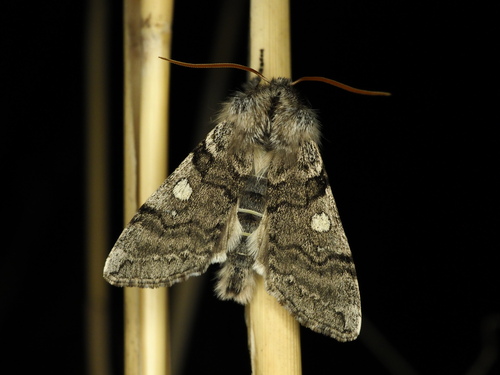
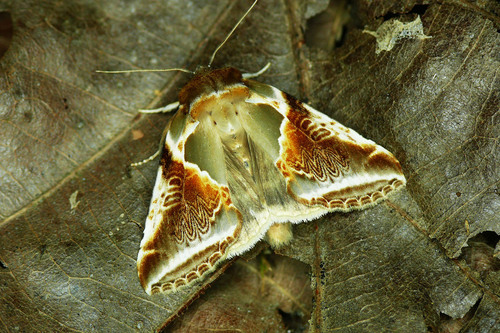
The buff arches, scientific name Habrosyne pyritoides, is a moth belonging to the family Drepanidae. This species was first described by Johann Siegfried Hufnagel in 1767. It is distributed across most of Europe, and is widespread in the British Isles, excluding the far north of England and the whole of Scotland. It inhabits deciduous and coniferous forests that support large populations of its foodplants, and can also be found in gardens and parks. This is a distinctive and attractive moth. Its grey-brown forewings are marked with prominent buff-orange arch-shaped patterns, which give the species its common name. The hindwings are grey with white margins. The moth has a wingspan of 40 to 45 millimeters. It flies from June to August in the British Isles; flight timing may differ in other parts of the species' range. It is attracted to both light and sugar. Young caterpillars are dark brown to grey-brown, and have more distinct spotting than later life stages. Mature caterpillars are brown-red, with a narrow dark dorsal line and faint pale spots along their sides. They have white spots on the sides of their first three abdominal segments; these spots decrease in size toward the rear of the body, or may only appear as a single spot on the first abdominal segment. The larvae feed on bramble, hawthorn, and hazel. The species overwinters in the pupal stage. Like many other insects, the buff arches has been severely impacted by light pollution, and its population has declined by 62% since the 1970s.