About Haaniella grayii (Westwood, 1859)
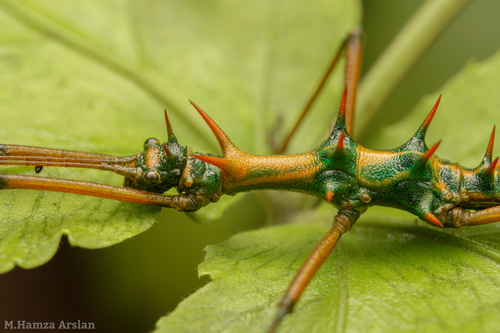
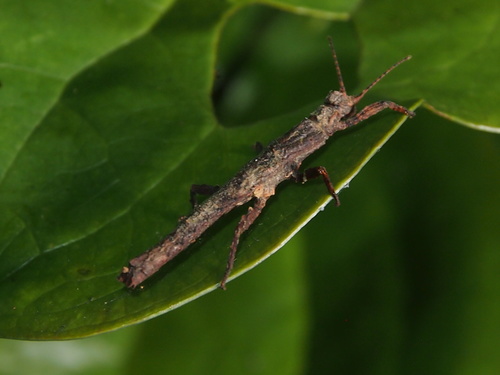
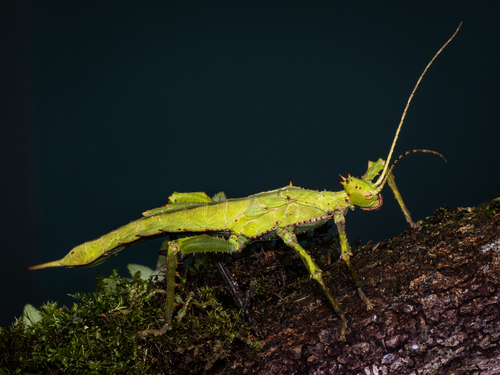
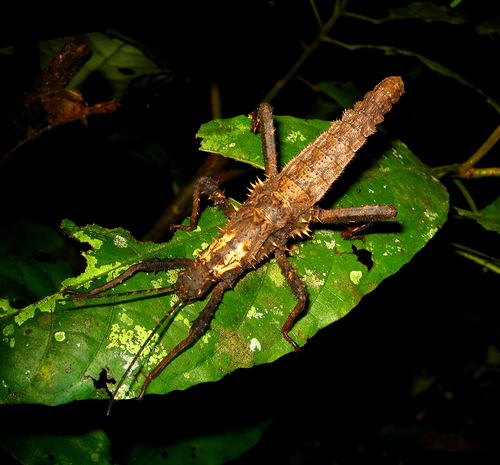
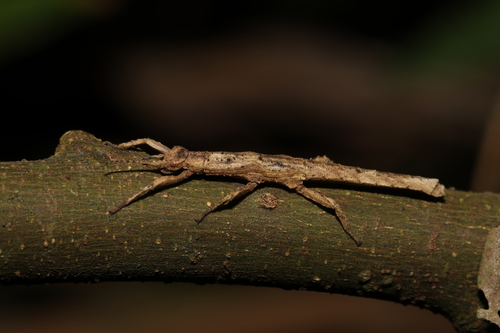
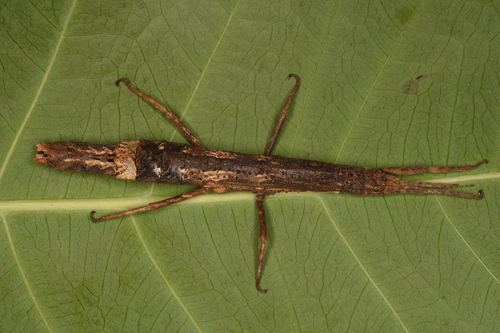
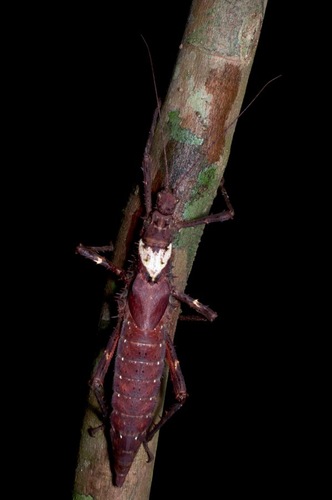
Like other species in the Haaniella genus, Haaniella grayii has sharp spines across the body and legs in both sexes. Also consistent with the genus, its forewings are strongly shortened and developed as tegmina, which completely cover the short hindwings that have been modified into stridulation organs. Males are slimmer, more colorful, have more spines on their backs, and remain smaller than females, measuring 78 to 95 millimetres (3.1 to 3.7 in) long, while females measure 102 to 143 millimetres (4.0 to 5.6 in) long. Females can be almost uniformly beige-brown, or more rarely brown to black-brown; there are also females with high-contrast light and dark brown patterns, which may have nearly white light patterns on the mesonotum, forewings, and abdomen. Females typically become slightly darker as they age. The abdomen of adult females swells noticeably due to egg development. The spine-shaped ovipositor is formed dorsally by the supraanal plate, which corresponds to the eleventh tergum. In Haaniella grayii, this ovipositor has six more or less distinct teeth. Unlike other Haaniella species native to Borneo, this dorsal portion of the ovipositor is longer than the lower part of the ovipositor, called the subgenital plate, which is formed from the eighth sternite. Synovial membranes, especially in the region of the hind and middle coxae, are pale green in females and bright green in males. In males, these green membranes, along with other green areas on the ventral side of the head and the meso- and metasternum, contrast with the red-brown color of the sternite edges and the coxae themselves. Bright green coloration on the spines is also typical of males. Often, the folded forewings are dark brown on the front side and white with brown veins on the back side. The arrangement of spines on the mesonotum of males is particularly specific to this species. Haaniella grayii has an extra pair of long spines on the mesonotum, located between the pair of long spines in the front part of the mesonotum and the formation of four spines in front of the forewing base that is seen in many Haaniella species. The distribution range of Haaniella grayii overlaps almost completely with that of Haaniella saussurei in western Borneo. Both species occur in the south-west of the Malaysian state of Sarawak, where H. grayii has been recorded on Mount Serapi up to an altitude of 300 metres (980 ft). Unlike H. saussurei, H. grayii can also be found in central areas of Kalimantan. H. grayii exhibits the defensive behavior typical of its subfamily: when touched by an attacker, it spreads its raised, spiked hind legs and closes them against the threat. The eggs of H. grayii are hairy and have a diagonally cruciform micropylar plate, with the micropyle positioned in the lower angle. Females lay their eggs into the ground at night. Eggs from specimens originating in Sarawak measure about 9.2 millimetres (0.36 in) long, 7 millimetres (0.28 in) high, and approximately 6 millimetres (0.24 in) wide. Eggs from Kalimantan-origin individuals have barely any hair, are on average slightly smaller, at 8.3 millimetres (0.33 in) in length, 6.5 millimetres (0.26 in) in height, and 5.7 millimetres (0.22 in) in width. Nymphs hatch after 9 to 18 months, and are already 35 millimetres (1.4 in) long at hatching. They reach adulthood after approximately nine months, and females begin laying eggs two months after becoming adult.