About Haaniella echinata (Redtenbacher, 1906)
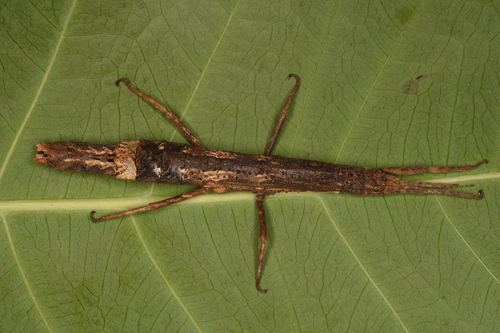
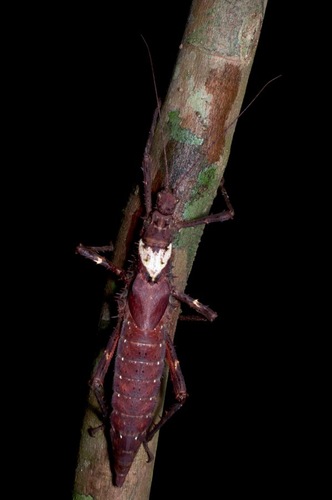
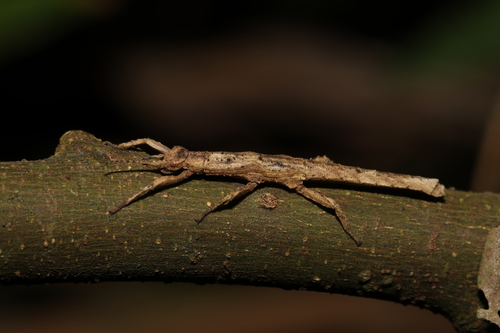
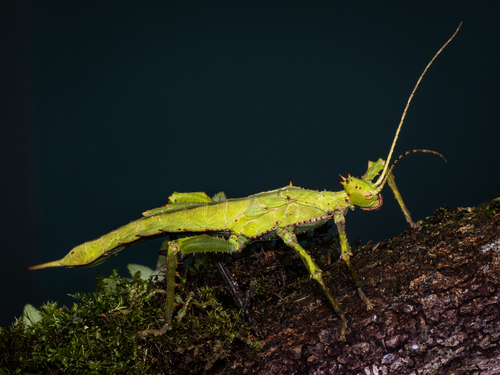
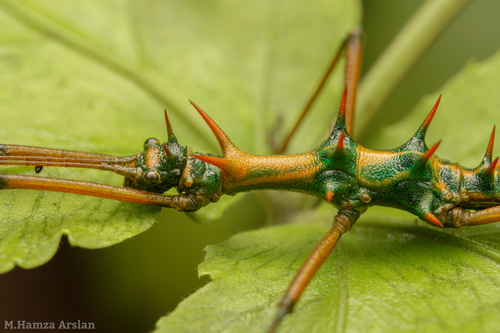
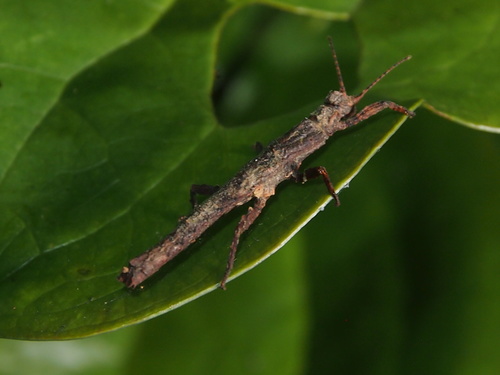
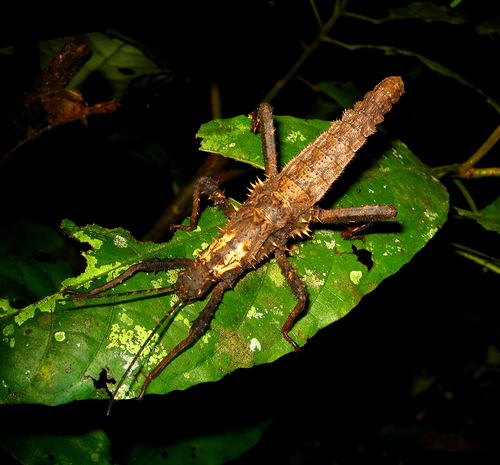
Like all members of the Haaniella genus, both sexes of Haaniella echinata have numerous sharp spines on the head. Both pairs of wings in this species are shortened: the forewings, which are modified into tegmina, completely cover the hindwings, which have been converted into stridulation organs. Unmistakable characteristics of this species are the bright turquoise-blue interarticular membranes on the coxae, and between the first abdominal sternites. These markings are already present in newly hatched nymphs, and form a clear contrast with the underside of the hind coxae and hind leg femurs, which are often distinctly bright red, especially in nymphs. In adult individuals, these areas are usually only colored reddish brown or orange, and the turquoise-blue color in adult males sometimes changes to turquoise green. Females reach a body length of 9 to 13.5 centimetres (3.5 to 5.3 in), and are only slightly smaller than Haaniella grayii, the largest known Haaniella species. The abdomen of females ends in the spine-like ovipositor that is typical of the subfamily Heteropteryginae. The ventral part of this ovipositor, called the subgenital plate or operculum, is usually slightly longer in female Haaniella echinata than the dorsal part, called the supraanal plate or epiproct. Four often indistinct teeth are located at the end of the epiproct. The operculum is keeled along its midline and rounded at the tip. Female base coloration is most commonly dark brown; light brown individuals are rarer. The larger spines are greenish in color. In many dark brown females, the area around the transition from the pronotum to the mesonotum is lighter and often has a faint greenish tinge. Some females also have light speckled spots on their legs or entire body. Males are significantly smaller than females, reaching a body length of 7 to 9.5 centimetres (2.8 to 3.7 in). Dark brown tones also usually dominate male coloration. In addition to the previously mentioned turquoise-green areas, the joint membranes of the front and middle coxae and the larger spines are typically a striking dark green. Many males have two light brown regions that run parallel to the body axis, extending across the entire pronotum to the anterior mesonotum, and are lightest at the transition between these two thoracic segments. The forewings of both sexes usually have very variable white patterns, which can be heart-shaped, wide or narrow "V"-shaped, "M"-shaped, or take other forms. Dark brown females may have no wing markings, just as fully speckled females can only have this white marking on their wings. This species is nocturnal, similar to other Bornean members of the Haaniella genus. Its defensive behavior involves spreading its raised, spined hind legs, then closing them when touched by an attacker. Eggs of this species are up to 12 millimetres (0.47 in) long and around 8 millimetres (0.31 in) wide, and are laid at night. Weighing 250 to 300 mg, the eggs are deposited into the ground using the female's ovipositor. Two forms of eggs exist: dark brown, bristly eggs with a flat lid (operculum), and lighter, barely hairy eggs with a lid that rises slightly conically toward the center. The diagonally cross-shaped micropylar plate, with the micropyle located at its lower angle, is easier to see on the lighter egg form. Nymphs hatch after 6 to 12 months. With a body length of 37 millimetres (1.5 in) and a compact build, newly hatched nymphs are among the largest and heaviest insect hatchlings. They already show the colorful underside markings described above. When they first hatch, they are brown on the dorsal side except for a white spot on each hind leg, and an abdominal segment with a white outer border. These white spots disappear in older nymphs, and the individuals gradually develop the adult coloration. They require 10 to 12 months to reach sexual maturity.