About Gyroporus cyanescens (Bull.) Quél.
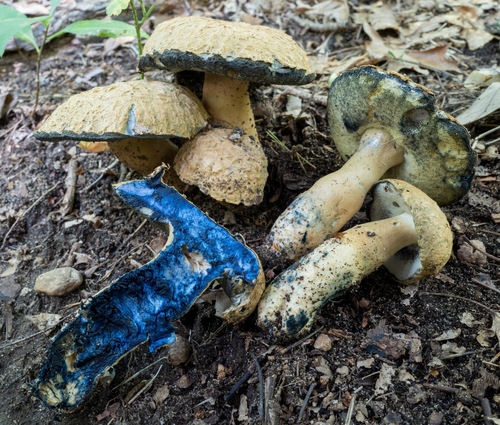
Gyroporus cyanescens, commonly known as the bluing bolete, has a cap that starts convex before flattening when mature, sometimes becoming slightly shallowly depressed, reaching 4–12 cm (1+1⁄2–4+3⁄4 in) in diameter. The cap surface is dry, uneven, and sometimes marked with wrinkles and pits; its color ranges from buff to yellowish to pale olive, and occasionally has darker color streaks. The cap edge is initially curved inward, and may split as the mushroom matures. The mushroom's flesh is whitish to pale yellow with a brittle texture. On the underside of the cap, the pore surface is white to yellowish, sometimes with olive or tan tinges. There are approximately two circular pores per millimeter, and the pore-forming tubes are 5–10 mm (1⁄4–3⁄8 in) deep, and are depressed around the top of the stem. When injured, the pores first stain greenish yellow, then turn greenish blue or blue. The stem measures 4–12 cm (1+1⁄2–4+3⁄4 in) long and 1–2.5 cm (1⁄2–1 in) thick; it is roughly uniform in width along its length, or sometimes develops a swelling at its base or middle. Stem tissue is hard and brittle; it is initially filled with soft pith that develops cavities, and becomes entirely hollow when the mushroom reaches maturity. The stem surface is dry, the same color as the cap or lighter, and lacks reticulations. It is initially covered in coarse hairs that usually wear away as the mushroom matures, leaving a relatively smooth surface. All parts of the mushroom's fruit body stain blue when cut or injured. The variety Gyroporus cyanescens var. violaceotinctus is nearly identical in appearance to the main variety, but stains dark lilac to indigo when bruised. The odor and taste of G. cyanescens fruit bodies are indistinct. The spore print is pale yellow. Spores are ellipsoid, smooth, and translucent (hyaline), measuring 8–10 by 5–6 μm. Spore-bearing basidia are club-shaped, produce two to four spores each, and measure 24–30 by 8–10 μm. Pleurocystidia, the cystidia found on the inner walls of the pores, are light yellow-brown, club-shaped, and uncommon, measuring 25–38 by 5.5-7.2 μm. Cheilocystidia, the cystidia found on the edges of the pores, are colorless and numerous, measuring 32–47 by 7–10 μm. Clamp connections are present in the fungal hyphae. Gyroporus cyanescens is an ectomycorrhizal species with a broad host range. Its fruit bodies grow singly or scattered on the ground in deciduous and mixed forests. It is often found growing with birch and poplar, tends to prefer sandy soil, and commonly grows along road banks and woodland edges. Fruiting occurs in summer and early autumn. Fruit bodies can be parasitized by the mold Sepedonium ampullosporum. Infection causes necrosis of the mushroom tissue and turns the tissue yellow, due to the production of large amounts of pigmented single-celled aleurioconidia (conidia formed by extrusion from conidiophores). This species is found in Europe, Asia, Australia, and North America, with fruiting in North America from July to September. In China, it has been recorded from Guangdong and Yunnan. In Australia, it grows in eucalypt woodland. In North America, it is widespread east of the Rocky Mountains, with a distribution ranging from eastern Canada south to Florida, and west to Minnesota. It has occasionally been reported from the Pacific Northwest, and one collection has been made in the Sky Islands of southern Arizona. The variety G. cyanescens var. violaceotinctus has been reported from Japan. Gyroporus cyanescens is edible, and is rated as "choice" by multiple sources. Even mature fruit bodies are typically free of insect larvae. Specimens collected from sandy soil are difficult to clean, but washing them in a bowl of water lets sand sink to the bottom to make cleaning easier. The blue staining largely disappears after two minutes of sautéing. Cooked G. cyanescens has a meaty texture and a mild nutty flavor that is improved when fried until crisp. Drying the mushrooms strengthens their flavor. The variety violaceotinctus is used for mushroom dyeing, and produces light yellow, beige, gold, or brownish-orange dye depending on the mordant used.