About Gyrocarpus jatrophifolius Domin
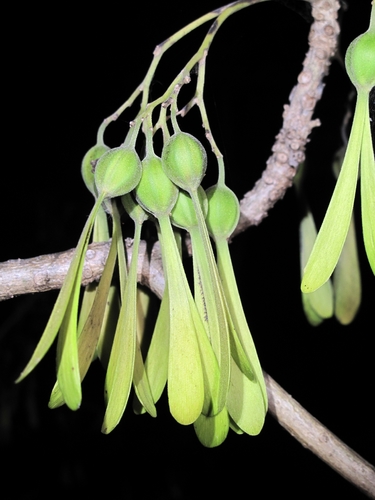
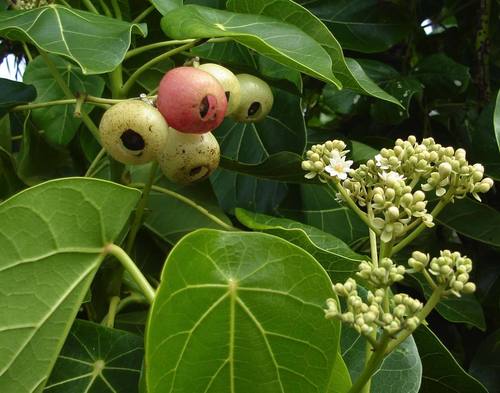
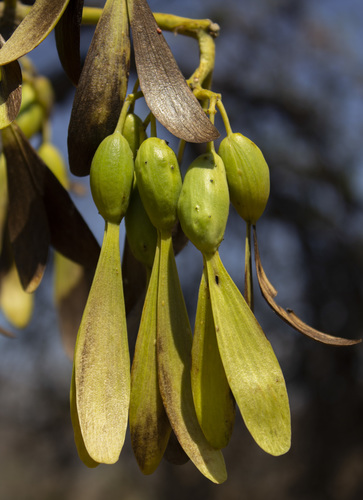
Gyrocarpus jatrophifolius Domin is a relatively understudied species, part of a genus that contains only five species. Its family is considered evolutionarily ancient, which may explain why the species has an unusual combination of features. During the dry season when the trees are leafless, numerous tiny green to yellowish-green flowers grow in dense panicle-type inflorescences that emerge near the tips of branches. This species is andromonoecious: flowers may be male with no female parts, making them sterile, or they may bear both male and female parts to produce fruits. The anthers of the five stamens release pollen through pores, where circular door-like "valves" open when conditions are favorable for pollen release. Flowers have 7-8 tepals that are only around 0.5 mm (about 1/50 inch) long. At the base of the flower's style is a single staminode, also around 0.5 mm tall, with a minutely granular surface. Fruits hang in clusters; each fruit has two downward-pointing winglike appendages formed by a pair of enlarged tepals, which can grow up to 12.5 cm long and up to 2.4 cm wide near their tips. Leaves are clustered at the ends of branches, with long petioles that can reach up to 42.5 cm (around 17 inches) long. Leaf blades are deeply 3-5 lobed, hand-shaped, and grow up to 45 cm (around 18 inches) in both width and length. Gyrocarpus jatrophifolius ranges from southern Mexico south through Central America into Costa Rica. It grows in tropical forests with extended dry seasons. In the Mexican state of Veracruz, this species is used to build living fences. In Michoacán, it is used to make watering troughs, canoes, yokes, wooden spoons, guitars and vihuelas.