About Gyps indicus (Scopoli, 1786)
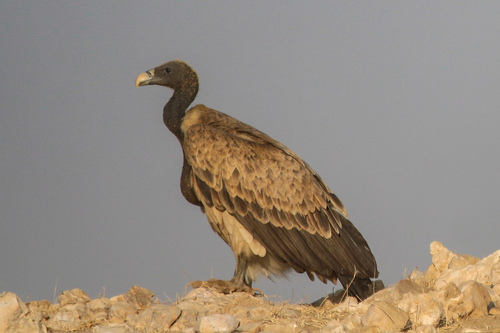
The Indian vulture, scientifically named Gyps indicus (Scopoli, 1786), is a bulky, medium-sized vulture. Its body and covert feathers are pale brown, with darker flight feathers. It has white thighs covered in scattered white fluff, broad wings, and short tail feathers. Its head is small, bare, and dark brown, with a long featherless neck, dark eyes, and a long yellowish beak paired with a pale green-yellow cere. This species measures 89–103 cm (35–41 in) in body length, has a wingspan of 2.22–2.58 m (7 ft 3 in – 8 ft 6 in), and weighs 5.5–6.3 kg (12–14 lb). It is smaller and less bulky than the Eurasian griffon, and can also be distinguished from that species by its wing coverts. The bald, nearly featherless head of the Indian vulture serves two key purposes. First, it helps the vulture regulate its body temperature: when cold, the vulture tucks its neck closer to its body to retain heat, and when hot, it extends its neck to cool down. Second, the lack of feathers keeps the head clean when the vulture feeds inside rotting animal carcasses. Historically, the range of the Indian vulture stretched from southeastern Pakistan across southern India, eastward to Indochina and the northern Malay Peninsula. It is now extinct in Southeast Asia, and most current populations live in central and peninsular India, south of the Gangetic plains. Small existing populations are also found in southwest Pakistan, Bangladesh, and Nepal. This species occupies a wide range of landforms, from semi-desert and dry foothills to open fields and arable lands near villages, as well as areas close to urban garbage dumps and slaughter houses. Indian vultures are not migratory, but they will travel hundreds of miles in a single day while scavenging for food. They nest on cliffs or tall buildings, and only rarely nest on trees; they will sometimes also build nests on old monuments and towers. The Indian vulture is a powerful flier that soars on thermal convection currents. It can glide at speeds up to 35 km/h (22 mph) and fly continuously for six to seven hours. It is usually found in small flocks, sometimes mixed with other vulture species. Indian vultures reach breeding age at around five years old. Nest building begins in September, and breeding activity occurs between November and March. They typically breed in monogamous pairs, and females lay only one egg per year. The egg is either pure white or mottled with rusty spots. Both parents take turns incubating the egg, which hatches after approximately 50 days. Nests are built as platforms made of sticks and twigs, lined with leaves. Green leaves are added to the nest to signal that the nest is occupied and to repel parasites. Nests are often placed near water sources such as rivers, lakes, or ponds to maintain the required humidity levels inside the nest. Almost 90% of Indian vulture nests are located at altitudes higher than 900 meters above sea level.