About Gyps coprotheres (J.R.Forster, 1798)
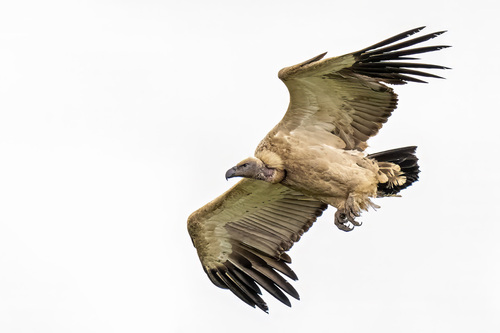
This large vulture, Gyps coprotheres, also known as the Cape vulture, has a creamy-buff body plumage that contrasts sharply with its dark flight and tail feathers. Adults are paler than juveniles, and their underwing coverts can look almost white when viewed from a distance. The head and neck are nearly featherless, or near-naked; adult eyes are yellowish, and the bill is black. Juvenile and immature Cape vultures are generally darker overall and have more prominent streaked patterning, with brown to orange eyes and red necks. It closely resembles the white-backed vulture, but the Cape vulture is larger and has yellow irises to distinguish it. The average length of an adult Cape vulture is 96–115 cm (38–45 in), with a wingspan ranging from 2.26–2.6 m (7 ft 5 in – 8 ft 6 in) and an adult body weight of 7–11 kg (15–24 lb). Like the white-backed vulture, the Cape vulture has two prominent bare skin patches at the base of its neck. These patches are thought to act as temperature sensors, helping the vulture detect thermals. The Cape vulture ranks among the largest raptors in Africa, alongside the lappet-faced vulture. With a mean body mass of roughly 8.9 to 9.22 kg (19.6 to 20.3 lb), the Cape vulture is significantly heavier than wild lappet-faced vultures, even though the lappet-faced vulture has an extremely large appearance. It is one of only a few native African flying birds that rival it for size, alongside the great white pelican and kori bustard. On average, the Cape vulture is the third largest Old World vulture, after the Himalayan griffon vulture and the cinereous vulture. The Cape vulture is a resident and breeding species in Botswana, Lesotho, Mozambique and South Africa. It occurs as a vagrant in the Democratic Republic of the Congo and Zambia, and it can also be found in Angola, Namibia, Zimbabwe and Eswatini, but does not breed in these areas. Cape vultures are obligate scavengers that feed exclusively on carrion, consuming soft muscle, organ tissues, and some bone fragments. They search for food in groups, and they can spot carcasses from long distances due to their good eyesight. This allows them to locate carcasses more quickly than other ground-dwelling scavengers.