About Gypohierax angolensis (Gmelin, 1788)
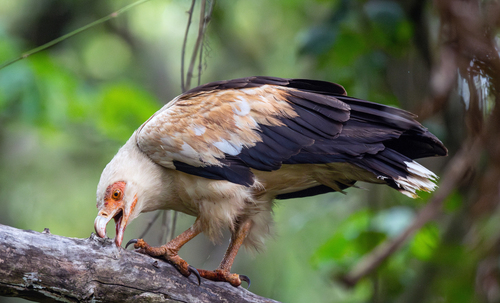
This bird, the palm-nut vulture Gypohierax angolensis (Gmelin, 1788), is easy to identify as an adult. It is the smallest Old World vulture, with a weight of 1.3–1.7 kg (2.9–3.7 lb), a length of 60 cm (2.0 ft), and a wingspan of 1.50 m (4.9 ft). Adult plumage is entirely white except for black areas on the wings and tail, and each eye is surrounded by a red patch. Males and females look identical and are the same size. Juveniles take 3–4 years to reach maturity; they are predominantly brown with yellow patches around the eyes and partially black wings, transitioning slowly to adult plumage over this period. In flight, this species looks more like an eagle than a typical vulture. It can maintain flapping flight, so it does not need to rely on thermals. Adults can be crudely mistaken for African fish-eagles or Egyptian vultures due to their extensive white plumage and black wing and tail feathers. However, palm-nut vultures clearly lack the chestnut body of the African fish-eagle and the white tail of the Egyptian vulture.
Palm-nut vultures are found across most coastal areas of the African continent, ranging from The Gambia to Kenya and south as far as South Africa. The total African population is estimated at 80,000 breeding pairs. There are approximately 40 individual palm-nut vultures in South Africa, and only South Africa and Mozambique host resident breeding pairs in Southern African subregions. During a 1970s census, the species' breeding distribution was centered on the Raffia palm groves of the Kosi Bay system and Mtunzini. At all permanently occupied sites, the species' distribution is tied to the presence of Raffia palms, specifically Raphia australis; the palm-nut vulture's presence at Mtunzini exists entirely because of artificial cultivation of Raffia palms. Currently, South Africa has 7 known nesting sites for the species, with a total population of 40 individual birds. As its common name suggests, the palm-nut vulture's distribution closely follows the range of oil palms (Elaeis guineensis) or raffia palms (Raphia sp.). Because of this association, it is most common in coastal forests and mangrove swamps located below 1,500 m (4,900 ft), but it also occurs in wet savannas.
Unusual for a bird of prey, the palm-nut vulture feeds mainly on the fleshy fruit husks of oil palm, the palm fruits of Raffia palms, as well as wild dates, oranges, other fruits, some grains, and acacia seeds. These fruits make up over 60% of an adult's diet, and over 90% of a juvenile's diet. It has also been recorded eating freshwater and marine crabs, molluscs, frogs, tadpoles, fish, dung beetles, termites, alate ants, alate termites, locusts, small mammals, birds and their nestlings, snakes, other reptiles, and even reptile eggs and hatchlings. It is also known to occasionally attack domestic poultry and feed on carrion.