About Gynostemma pentaphyllum (Thunb.) Makino
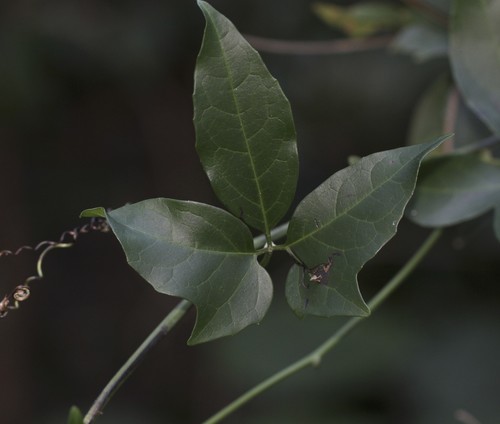
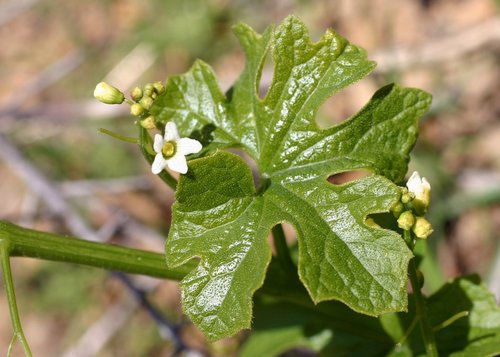
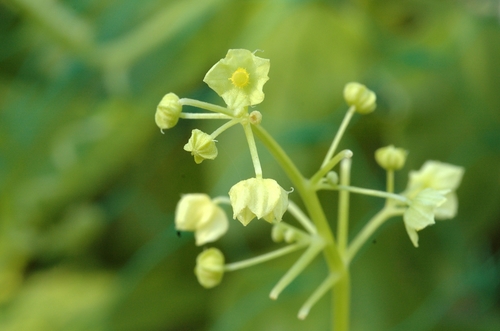
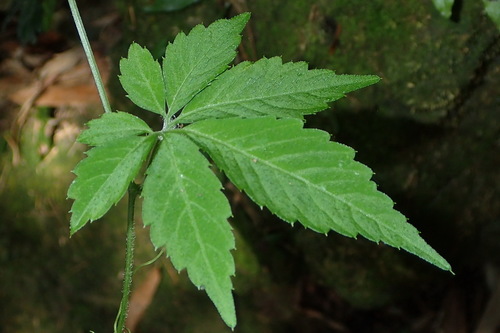
Jiaogulan, scientifically named Gynostemma pentaphyllum (Thunb.) Makino, belongs to the genus Gynostemma in the Cucurbitaceae family, which also includes cucumbers, gourds, and melons. It is a climbing vine that uses tendrils to attach itself to supporting structures. Its leaflets have serrated edges, and most commonly grow in groups of five, matching the species epithet pentaphyllum; some related species have leaflet groups of three or seven instead. This plant is dioecious, meaning every individual plant is either male or female. To produce seeds, you must grow both a male and a female plant together. The fruit of jiaogulan is a small, purple, inedible gourd. Jiaogulan grows prolifically in the wild, is widely cultivated, and has become naturalized in dry regions of the United States. The genus Gynostemma contains approximately 17 species total, nine of which are endemic to China. G. pentaphyllum itself has a wide distribution outside of China, ranging across India, Bangladesh, Southeast Asia, Japan, Korea, and New Guinea. In China, this species grows on mountain slopes in forests, thickets, and along roadsides, at elevations between 300 and 3,200 meters (980 and 10,500 feet) above sea level. Jiaogulan is a vine hardy to USDA zone 8, where it grows as a short-lived perennial. In most temperate climates, it can be grown as an annual, in well-drained soil with full sun exposure. It does not grow well in cold climates that experience temperatures below freezing. Jiaogulan is used in folk medicine, most commonly prepared as a herbal tea, but may also be made into an alcohol extract or included in dietary supplements. It has not had widespread use in traditional Chinese medicine, and has only been adopted in the practice in the last 20 years. In China, it grows mainly in Guizhou province. In the European Union, jiaogulan is classified as a novel food after a 2012 court ruling that prohibited its sale as food.