About Gymnura poecilura (Shaw, 1804)
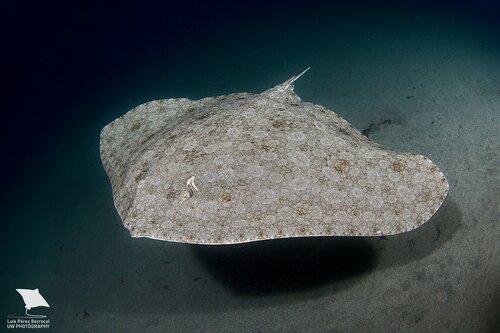
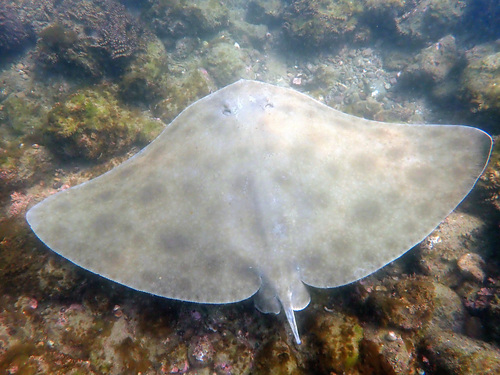
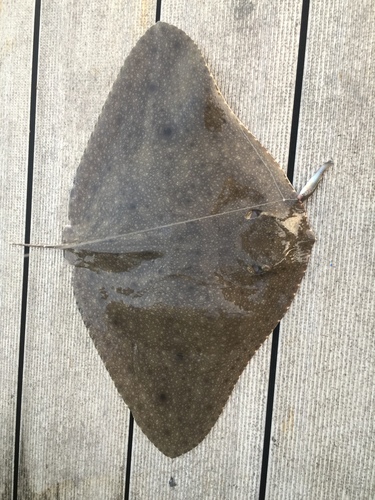
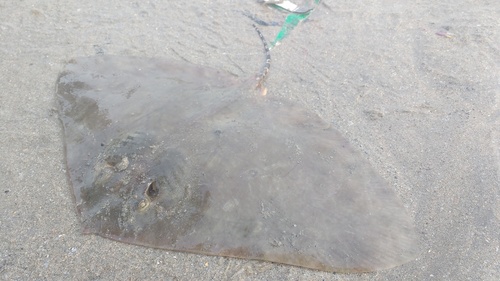
Gymnura poecilura, commonly known as the longtail butterfly ray, has a pectoral fin disc of the lozenge shape characteristic of its family, measuring around twice as wide as it is long. The leading margin of the disc is gently sinuous, the trailing margin is convex, and the outer corners are mildly angular. Its snout is short and broad, with a tiny protruding tip. It has medium-sized eyes, with larger spiracles that have smooth rims positioned behind the eyes. Its nostrils sit close to the mouth, and between the nostrils is a short, broad curtain of skin with a smooth margin. The large mouth forms a transverse curve, and holds over 50 tooth rows in each jaw; this number increases as the ray ages. The teeth themselves are small, narrow, and pointed. There are five pairs of short gill slits on the underside of the disc. The pelvic fins are small and rounded. The thread-like tail has no dorsal or caudal fins, though low ridges run along its length on both the upper and lower sides. The tail length is about equal to the distance between the tip of the snout and the vent, a trait that distinguishes this species from other butterfly rays which have shorter tails. Sometimes there is a small stinging spine, very rarely two, on the upper surface of the tail near its base. The ray’s skin has no dermal denticles. The upper side of this species ranges in color from brown to greenish brown to gray, with many small pale spots, and sometimes a scattering of dark dots as well. The tail has nine to twelve black bands that alternate with white bands; the white bands often contain a small dark spot on their upper surface. The underside is white, and darkens at the edges of the fins. This species reaches a maximum total disc width of 92 cm (36 in).
This is the most widespread member of its family in the Indo-Pacific. It occurs from the Red Sea and Somalia, westward across India and Sri Lanka, to China and southern Japan, the Philippines, and the western islands of Indonesia, including Borneo, Sumatra, and Java. It has also been reported from French Polynesia, as noted in the taxonomic information above. It is fairly common in some areas. This bottom-dwelling species lives in coastal waters at depths of 10–30 m (33–98 ft), and prefers sandy or muddy bottoms. It does not appear to migrate seasonally.
The longtail butterfly ray preys on bony fishes, especially ponyfishes of the genus Leiognathus, and also eats molluscs and crustaceans. It is not known to form large schools. Documented parasites of this ray include the nematode Hysterothylacium poecilurai and the tapeworm Acanthobothrium micracantha. Like other butterfly rays, this species is viviparous: embryos are first sustained by yolk, and later receive nutrition from histotroph, also called "uterine milk", produced by the mother. Adult females have two functional ovaries and two functional uteruses. Reproductive activity occurs year-round, with a peak between April and October. The length of the gestation period is unknown, but it is possible that females produce more than one litter per year. Litter size is at least seven pups, and litter size does not correlate with female size. Newborn rays measure 20–26 cm (7.9–10.2 in) across the disc, and are stingless miniatures of adults. Sibling pups may differ from one another in coloration. Males reach sexual maturity at roughly 45 cm (18 in) across the disc, while females mature at roughly 41 cm (16 in) across.