About Gymnura lessae Yokota & Carvalho, 2017
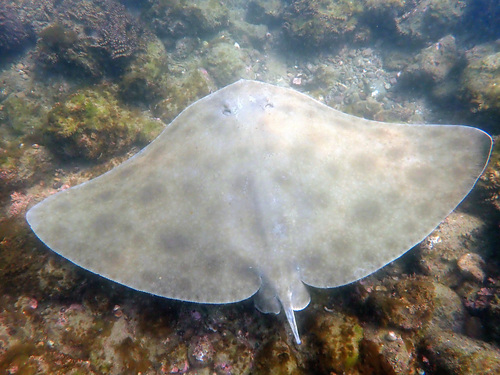
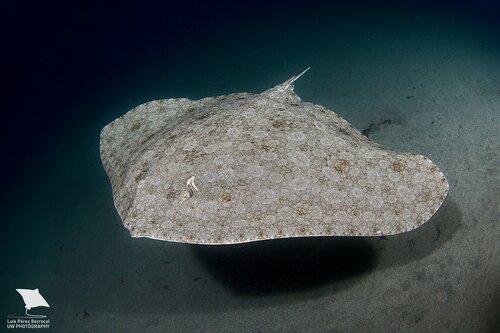
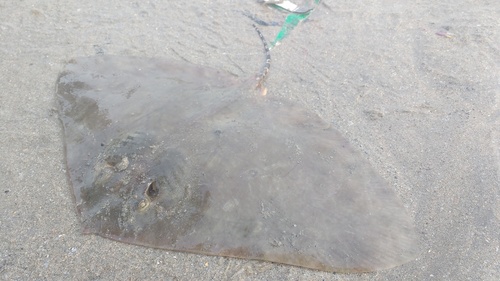
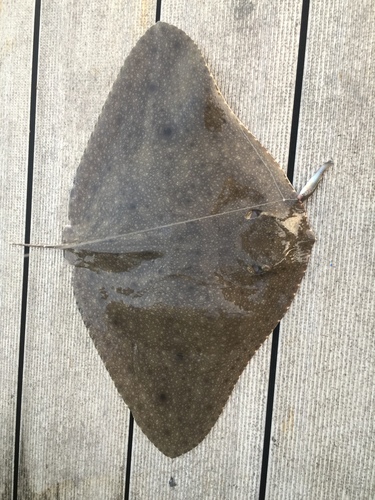
Morphology: Like many butterfly rays, G. lessae has a flat diamond-shaped body, a wide disc, and a short tail. External traits such as body color vary between the anterior and posterior sides of the body, between different individuals of this species, and across other species in the family Gymnuridae. The posterior side is darker in tone, with radial projections that are visible near the base of the pectoral fins (wings), while the anterior side is much lighter in tone. G. lessae can be distinguished from other gymnurids, especially Gymnura micrura, by differences in the cartilage of the pectoral girdle and hyomandibula. At maturity, G. lessae has an overall smaller body size and a simpler brain than other batoids. The cerebellum of G. lessae has a smaller surface area relative to its volume, due to reduced foliation. The positioning of several cranial nerves is detailed in a referenced table. Distribution and habitat: Gymnura lessae occurs along a long stretch of the eastern coast of North America, ranging from Rhode Island (US) through the Gulf of Mexico (including Louisiana and Texas, US) to Tamaulipas and Campeche, Mexico. It inhabits neritic environments, prefers sandy and muddy bottoms, and can be found at depths up to 60 m (200 ft). Reproduction and growth: Gymnura lessae is a viviparous, sexually dimorphic ray. Females grow larger than males, reaching a maximum disc width (DW) of 460 mm (18 in), while males reach a maximum DW of 340 mm (13 in). Males reach sexual maturity faster than females, and both sexes grow rapidly and have high fertility. These traits make G. lessae resistant to exploitation, leading to its classification as a stable population and a species of least concern, compared to many other threatened rays.