About Gymnura altavela (Linnaeus, 1758)
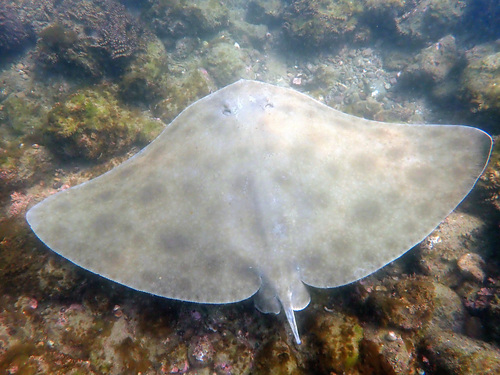
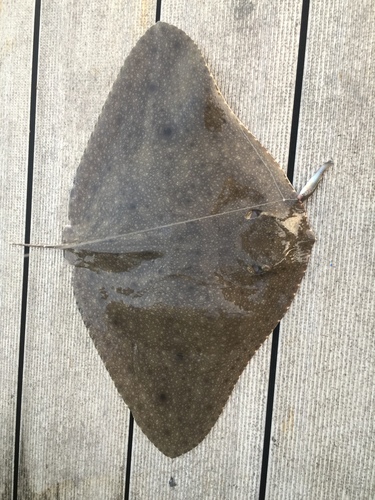
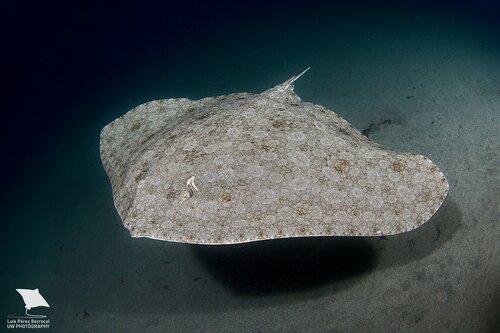
Gymnura altavela, commonly called the spiny butterfly ray, has a very broad, lozenge-shaped pectoral fin disk that is much wider than it is long, with concave front margins and abruptly rounded corners. Its snout is short and blunt. Its teeth have high, conical cusps, arranged in 98 to 138 rows in the upper jaw and 78 to 110 rows in the lower jaw. Both jaws hold 10 to 12 functional tooth rows, and each dental band takes up 70% of the jaw's width. A tentacle-like structure grows on the inner posterior margin of each spiracle. The ray's tail is short and slender, measuring one quarter of the disk's width, and has upper and lower fin folds. One or more serrated spines are present at the base of the tail. Juvenile and subadult rays have naked skin, while adults develop a patch of denticles at the center of the disk. The ray is dark brown on its upper side, sometimes marked with small lighter or darker spots and blotches in a marbled pattern, and white on its underside. Juvenile rays have pale crossbars on their tail. The maximum confirmed size is a 2.2 m (7 ft 3 in) disk width in the northwest Atlantic, though unsubstantiated reports exist of rays over 4 m (13 ft) off the coast of West Africa. The maximum published weight for the species is 60 kg (130 lb). This species has a patchy, discontinuous distribution across tropical and warm-temperate waters of the Atlantic Ocean. In the western Atlantic, it occurs from Massachusetts, United States to Buenos Aires Province, Argentina; it is rare in the Gulf of Mexico and common at the mouths of tidal creeks along the Virginia coast. In the eastern Atlantic, it is found from Portugal to Angola, including Madeira and the Canary Islands. It has also been recorded in the Mediterranean and Black Seas. It lives in shallow brackish and coastal waters over soft sandy or muddy substrates, at depths between 5 and 100 m (16–328 ft). The spiny butterfly ray is uncommon globally, but can be locally abundant in habitats that suit it. Individuals may segregate by sex: females usually stay in deeper water, and move inshore to breed. In the western Atlantic, the spiny butterfly ray feeds on fishes including Leiognathus and small sharks, plus squids. Off the coast of Tunisia, it feeds on crustaceans, teleosts, cephalopods, lamellibranchs, and gastropods, listed from most to least important. Teleost fish appear to become a more important part of the ray's diet as it grows larger. This ray is an active predator: it typically approaches prey slowly, then rapidly spins around over the prey and strikes it with the leading edge of one pectoral fin. This behavior likely stuns prey before capture, because butterfly rays' pectoral fins contain a high proportion of red muscle and can deliver forceful blows. Known predators of spiny butterfly rays include larger fish such as the great hammerhead (Sphyrna mokarran), and marine mammals. In the northwest Atlantic, commercial fishing has depleted seven large shark species, which has led to population increases for the spiny butterfly ray and other mid-level predators. Documented parasites of this species are the tapeworms Anthobothrium altavelae and Pterobothrioides petterae, and the gill parasite Heteronchocotyle gymnurae. Spiny butterfly rays are ovoviviparous and give birth to live young. They have an annual reproductive cycle with a gestation period lasting 4 to 9 months. Embryos initially rely on a yolk sac for nutrition; later in development, long villi grow from the uterine wall into the embryos' spiracles, which direct uterine milk into the embryos' oral cavity. Litter sizes reach up to 8, varying by geographic location: 4 young per litter in the Gulf of Mexico, 1 to 6 in the Mediterranean, up to 5 off Brazil, and up to 8 in the northwest Atlantic. Females have one functional ovary (the left one) and two functional uteruses, with embryos distributed evenly between the two uteruses. Newborn rays measure 38 to 44 cm (15–17 in) across the disk; newborn size is inversely related to the number of young in each uterus. In the eastern Atlantic, males reach sexual maturity at around 78 cm (31 in) across the disk, while females mature at around 108 cm (43 in). In the western Atlantic, males mature at around 102 cm (40 in) across the disk, and females mature at around 155 cm (61 in). Females mature later than males and grow to a larger adult size.