About Gymnothorax undulatus (Lacepède, 1803)
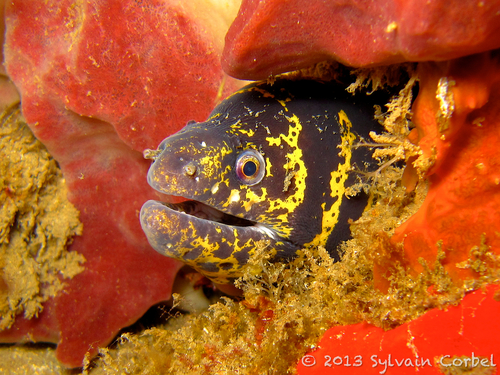
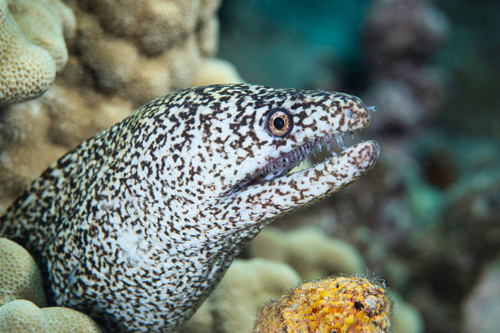
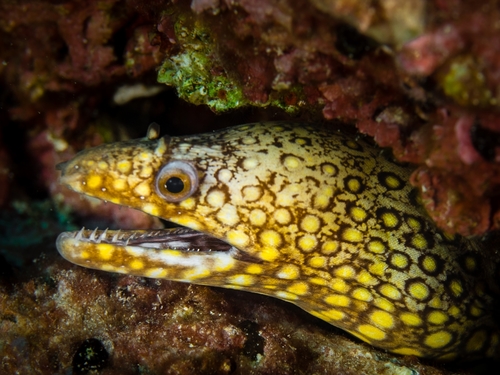
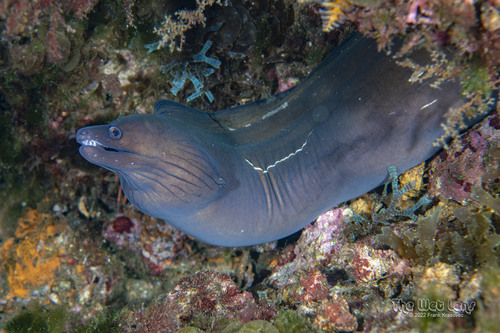
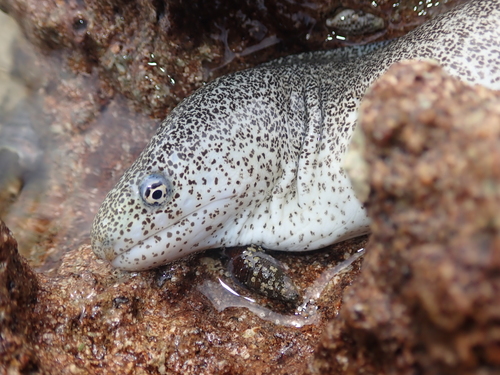
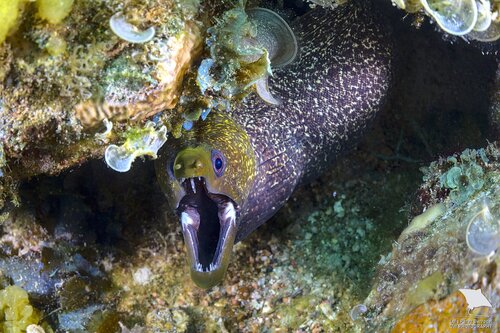
The undulated moray, Gymnothorax undulatus, can be easily identified by its yellow head and brown spots covering its body. White lines with white borders pattern its body, forming a shape similar to chain link. This species uses its large mouth to pump water to the gills, and its gill cover is a small hole that protects the delicate gills. Like most eels, undulated morays lack pectoral and pelvic fins, which makes it easier for them to move through the crevices of reefs. Their other fins are covered in thicker skin to protect them from sharp reef. They move in an S-shape, allowing them to move back and forth, which also aids movement through reef crevices. Their teeth are curved backwards, letting them hold onto prey and move prey backwards easily for digestion. Gymnothorax undulatus is found in the Pacific Ocean and East Africa. Individuals are most often found on lagoon reefs, seaward reefs and reef-flats. They shelter within reefs, and occur at depths from 1 to 50 meters. The undulated moray is a nocturnal species: it hides in reefs during the day and hunts for food at night. In Hawaiian culture, the undulated moray and several other eel species, collectively called puhi, are common ʻaumakua featured in many Hawaiian stories. They are thought to be ancestors that protect families. This eel is called laumilo, meaning "milo leaf", named for its swimming movement that resembles a milo tree leaf blown by the wind. According to the Kumulipo, this eel is considered a guardian of the milo tree. It was also a common form that Kū, the Hawaiian god of war, would take to interact with humans. For many native Hawaiian communities, eels were an important food source, and were used in special dishes served when leaders hosted special guests. This particular eel is deemed "highly relished".