About Gymnothorax funebris Ranzani, 1839
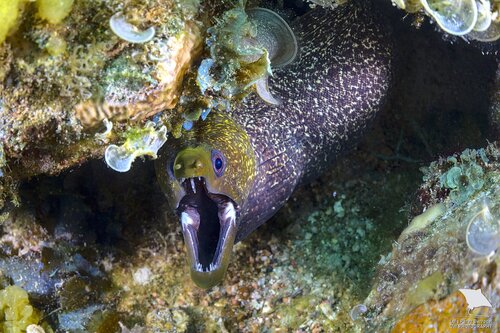
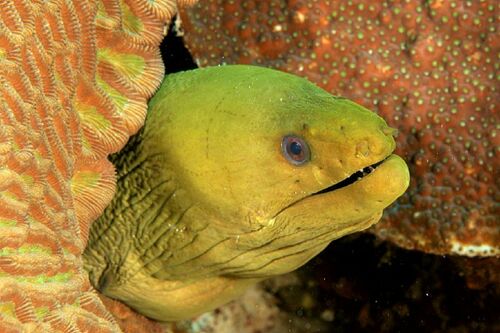
Gymnothorax funebris, commonly called the green moray, is a moray eel belonging to the family Muraenidae. It is found in the western Atlantic Ocean, ranging from Long Island, New York, Bermuda, and the northern Gulf of Mexico south to Brazil. It inhabits waters at depths down to 40 metres, or 130 feet. This species can reach a maximum length of 2.5 metres, or 8.2 feet, making it the largest moray species in the tropical Atlantic, and one of the largest known moray eel species. The common name "green moray" is sometimes also used to refer to the yellow moray, G. prasinus. The green moray's characteristic green colour comes from a protective mucus layer secreted by its specialized goblet cells, a trait it shares with many other moray species. Under this mucus layer, the green moray has a darker body colour, a feature that can be observed in preserved specimens. Green morays are typically not consumed by humans, because eating them can cause ciguatera fish poisoning, also known as CFP. Although the green moray itself is not classified as endangered, moray eels as a group are generally under-studied, and are often under-counted by traditional visual survey methods. The IUCN has rated the green moray as Least Concern, and there are no notable threats to the species beyond occasional capture to be held in public aquaria.