About Gymnosporia nemorosa (Eckl. & Zeyh.) Szyszyl.
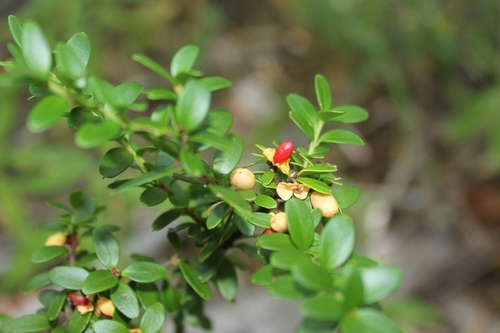
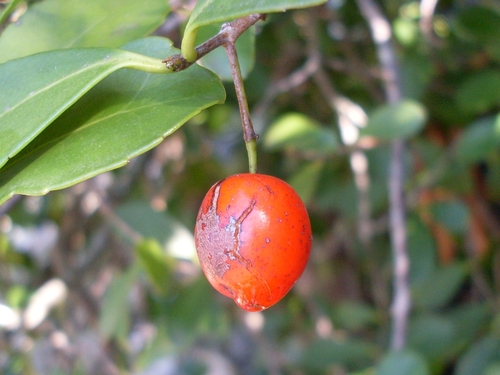
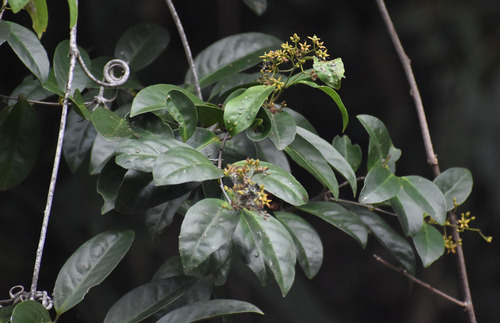
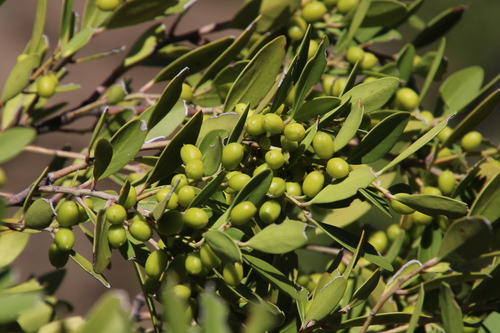
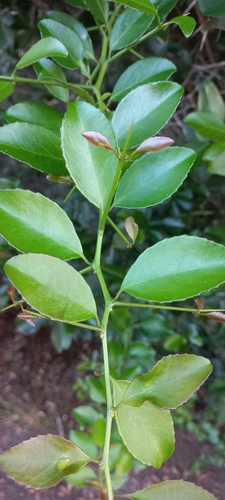
Gymnosporia nemorosa (Eckl. & Zeyh.) Szyszyl. is typically a spiny, somewhat sprawling evergreen shrub or small tree with drooping branches, reaching around 5 m in height. It grows along forest edges in Mpumalanga, Eswatini, and KwaZulu-Natal, extending south to the Garden Route in the Southern Cape. In Maputaland, this species takes the form of a geoxylic suffrutex, or ‘underground’ tree, with new shoots sprouting from its woody underground axis. Its fragrant white unisexual flowers grow in clusters in the axils of leaves on lateral shoots that resemble spines. The species produces dusky-pink, pear-shaped, pendulous fruits that are about 15 mm in both length and diameter. The fruits dehisce along three longitudinal lines to create 3 valves that curl back from the distal end, revealing orange arils that enclose the seeds. Its leaves are alternate or tufted, hairless, leathery, 25–50 mm long, with slightly serrate margins, and ovate to round in shape. They are glossy and dark green above, paler beneath, and range from emarginate to acute with a depressed apex. Its branchlets are spiny and densely dotted with pale lenticels. Larvae of the African moth Drepanogynis cambogiaria (Guenée, 1858) feed on this species, as well as on other members of the Celastraceae. This is one of the species frequently browsed by black rhinoceros in Hluhluwe–iMfolozi Park. This taxon was formerly described as Celastrus nemorosus, characterized as glabrous and spiny with strong spines. Its leaves are tufted or solitary on twigs, elliptical to rounded, obtuse or shortly emarginate, with dentate-serrate margins, shortly cuneate at the base, sub-coriaceous and veiny. Axillary cymose panicles are shorter than or equal in length to the leaves, and capsules are trigonous with 2 to 3 seeds. It is very similar to the preceding related species, but differs in having broader and rounder leaves that are not much narrowed at the base, and are clearly serrate or toothed. It is also related to C. verrucosus, which is distinguished by its foliage, warty branches, and different fruit. Its branches are terete, sometimes somewhat warty, and its twigs are somewhat angular. Under the synonym description, leaves are glaucous above and livid below with raised nerves; larger leaves measure 2–2 1/2 inches long and 1–1 1/2 inches wide, while smaller leaves are one inch long. Panicles are many-flowered, with a variant form having looser and longer panicles. Flowers match those of C. buxifolius, capsules are 3 lines long, and specimens have been collected at Kragga kamma, Adow, Olifantshoek, Hassagaisbosch, Howiesons Poort and Port Natal.