About Gymnosporia laurina (Thunb.) Szyszyl.
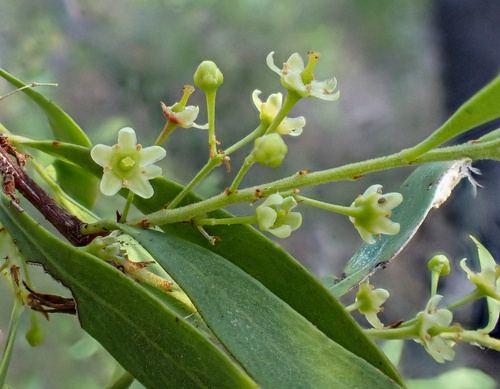
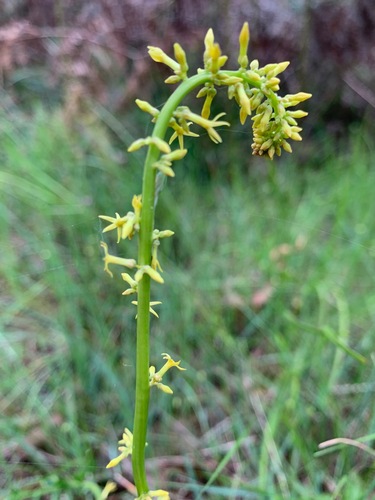
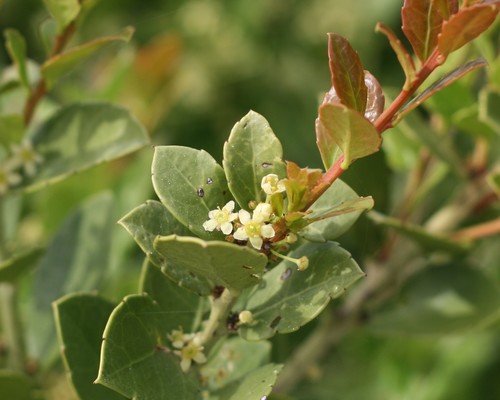
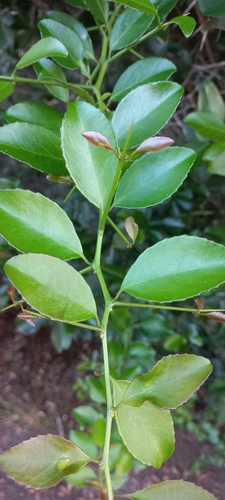
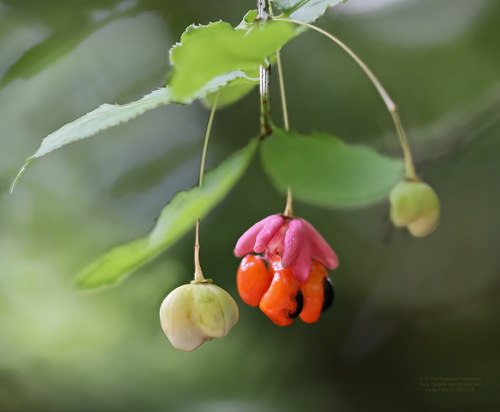
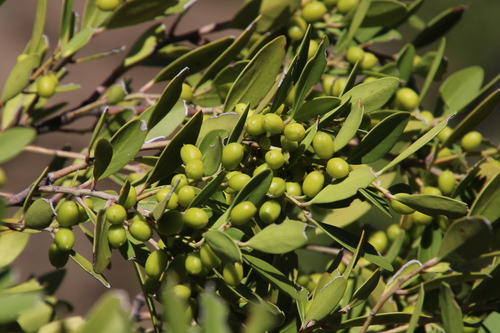
This entry was originally described under the synonym Maytenus oleoides, with the currently accepted scientific name being Gymnosporia laurina (Thunb.) Szyszyl. The bark is greyish-brown, smooth on young individuals and becoming rugged, corky, and marked with vertical grooves and transverse cracks as the tree ages. Leaves are alternate, oval with a narrow base, stiff and leathery, and mid-green with a bluish tinge. Leaf margins are inrolled and smooth, and the leaf apex is rounded, sometimes notched. Leaf midribs are ridged, and unlike some other Maytenus species such as Maytenus acuminata, no pale threads connect the two halves when a leaf is snapped in half. Young new foliage is reddish. Flowers are small and grow in clustered groups in the leaf axils. The typical flowering season runs from August to November, though some cultivated specimens at Kirstenbosch National Botanical Garden flower in May and June. Fruits are about 1 cm (0.4 in) in diameter, forming a fleshy pale green two-lobed capsule. This capsule dries and turns pale orange during summer, then splits open to reveal seeds that are each covered by a yellow aril. This species is native to South Africa, where it occurs in the Eastern Cape, parts of the Northern Cape, and the Western Cape – including the Groot Winterhoek Mountains, Table Mountain, and the Cape Peninsula. At high altitudes, it grows as a shrub or dwarf tree, while at lower elevations it develops into a more robust small tree, reaching up to 6 m (20 ft) tall with a spreading crown. It grows most often in stream-side woodland and on scree slopes. Its native habitat has a climate of cool moist winters and dry warm summers, with an average annual precipitation of 160 cm (63 in), most of which falls between May and August. The fynbos shrublands of South Africa are prone to wildfires, which occur roughly every twenty years. Interspersed within these shrublands are patches of evergreen forest that make up around 10% of the landscape, and these forests are composed primarily of Maytenus oleoides, Cunonia capensis, Kiggelaria africana, Ilex mitis, and Brabejum stellatifolium. Wildfires may burn the leaf litter of these forest patches, but will only spread into the tree canopy if the fire is extremely intense. This resistance to crown fire is likely because the tree foliage has a higher moisture content than the foliage of surrounding fynbos shrubs. Even if foliage does not burn, trees may be scorched by fire, but they have strong regenerative capacity and readily sprout new growth from blackened branches.