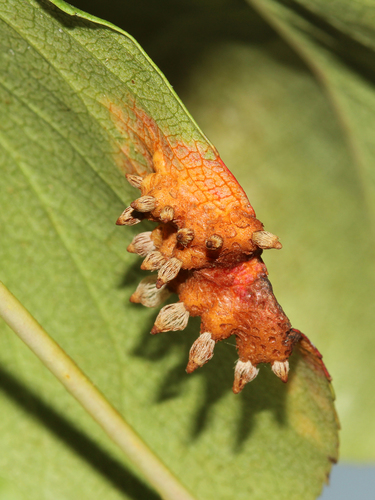
About Gymnosporangium sabinae (Dicks.) G.Winter
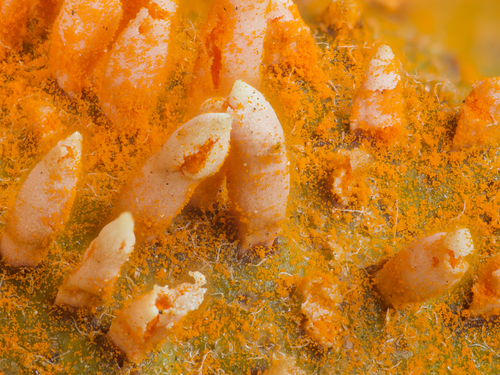
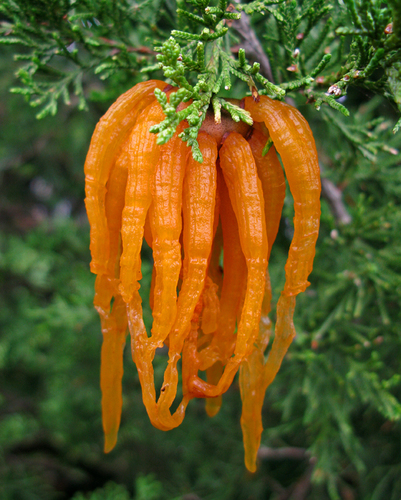
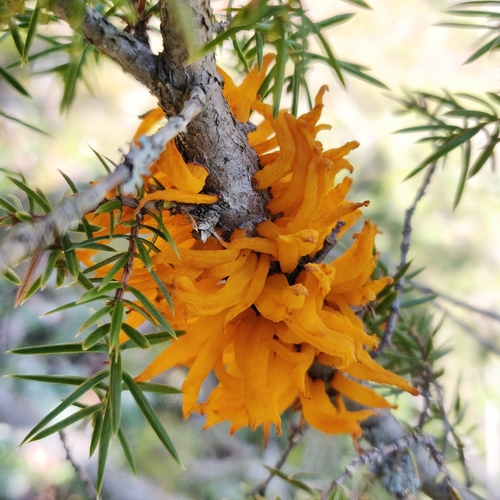
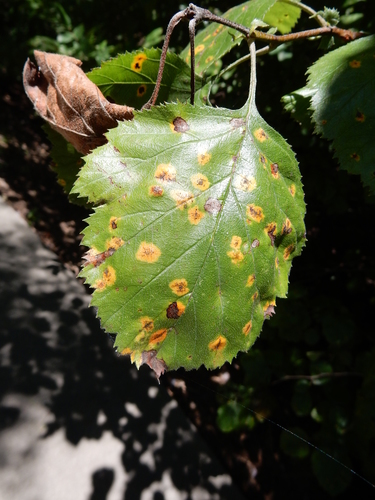
Gymnosporangium sabinae (Dicks.) G.Winter is a species of rust fungus belonging to the subdivision Pucciniomycotina. It is commonly known as pear rust, European pear rust, or pear trellis rust. This fungus is a heteroecious plant pathogen, with Juniperus sabina (savin juniper) as its main primary (telial) host, and Pyrus communis (common pear) as its main secondary (aecial) host. While Juniperus sabina is the main primary host, G. sabinae also infects Juniperus chinensis and other species within Juniperus sect. Sabinae. The north European species Juniperus communis (common juniper) is not a host for this fungus. The main secondary (aecial) host is Pyrus communis (common pear), but other pear species, including the ornamental Pyrus calleryana (Bradford pear), are also susceptible to infection. The native distribution of Gymnosporangium sabinae matches the native ranges of its two main hosts. Juniperus sabina, a montane shrub, is native from southern Europe and the Alps into North Africa and Asia, while Pyrus communis (common pear) is native to continental Europe, the Middle East, and western Asia. However, the fungus has expanded its range in Europe as far north as Scandinavia and the British Isles, driven by the widespread use of savin and other junipers as ornamental garden shrubs. Gymnosporangium sabinae has also been reported to occur in North America, and pear rust caused by this fungus is a regulated disease in some countries. Like many rust fungi, G. sabinae needs two different host species to complete its annual life cycle: juniper acts as the winter host, and pear acts as the summer host. Aeciospores, the spores produced by lantern-shaped fungal growths protruding from blisters on the underside of pear leaves, become airborne and infect juniper plants. The fungus overwinters inside swellings or galls on the infected twigs and branches of susceptible junipers. In spring, following rain or heavy dew, the galls on juniper produce tiny dark horn-shaped growths that become covered in an orange-brown gelatinous mass called telia. The equivalent stage on pear trees is called aecia. Telia release teliospores (wind-borne resting or hibernating spores) that infect susceptible pear leaves, while aecia release aeciospores that are wind-borne and infect susceptible junipers respectively. Spores produced from fungus-induced swellings on juniper stems can remain infectious and travel up to 6 km. Infection causes yellow-orange spots that turn bright red on pear tree leaves. The disease can be particularly damaging to pear trees; if left untreated, it can lead to complete defoliation and total crop loss. The fungus feeds on the living cells of its host plant, and cannot survive on dead plant material. As a result, it must either alternate between two different hosts or produce resting spores to survive through the dormant season.