About Gymnosarda unicolor (Rüppell, 1836)
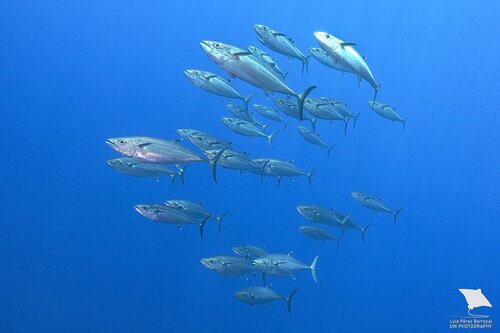
Dogtooth tuna (Gymnosarda unicolor) has different size ranges for males: the maximum recorded length for males is between 190 and 248 centimetres (75 to 98 inches), and the maximum recorded weight reaches 130 kilograms (287 pounds). The average length of commonly observed individuals is around 40 to 120 centimetres (16 to 47 inches). This species has 12 to 14 soft dorsal rays and 12 to 13 soft anal rays. Its lateral line has a strong undulating pattern. These large tunas have a streamlined body shape with distinctive coloration: brilliant blue-green on the back, silvery on the sides, and whitish on the belly. The two dorsal fins located close to the caudal peduncle each have a white tip. Dogtooth tuna always swim with their jaws open, and the upper jaw of their large mouth extends back to reach the eye. Dogtooth tuna is widely distributed across tropical waters of the Indo-Pacific region. Its range extends from the eastern coast of Africa (including the Red Sea) to French Polynesia and oceanic islands of the Pacific Ocean, excluding Hawaii. It can also be found as far north as Japan and as far south as Australia. This is an offshore species that occurs mainly in reef environments. Smaller individuals are more commonly found near shallow reef areas, while larger individuals inhabit deep reef drop-offs, seamounts, and steep underwater walls. Dogtooth tuna are usually solitary or swim in small schools, and can be found at depths ranging from 10 to 300 metres (33 to 984 feet). Dogtooth tuna is an apex non-pelagic predator within its range, sharing this position with giant trevally, Napoleon wrasse, large groupers, and large sharks including reef sharks, bull sharks, and tiger sharks. It is an aggressive opportunistic predator that feeds on small schooling fishes and squid, and is able to consume a wide variety of prey. In most of its range, the main part of its diet is likely made up of pelagic schooling fish found near reef habitats, including Caesio, Cirrhilabrus, Pterocaesio, carangids such as rainbow runners and Decapterus, mackerel scad, and scombrids. Preliminary estimates of longevity show the maximum observed age of this species is at least 20 years.