About Gymnorhina tibicen (Latham, 1802)
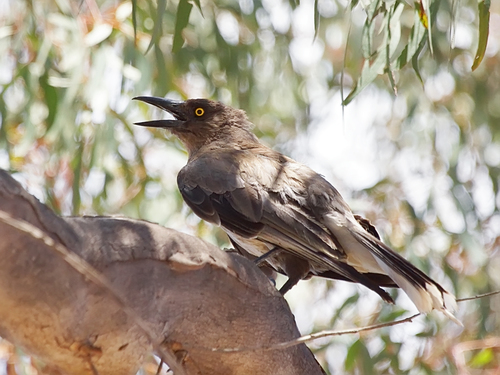
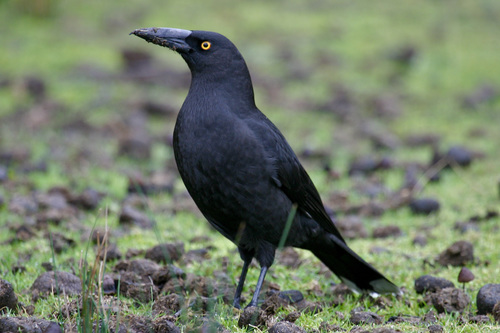
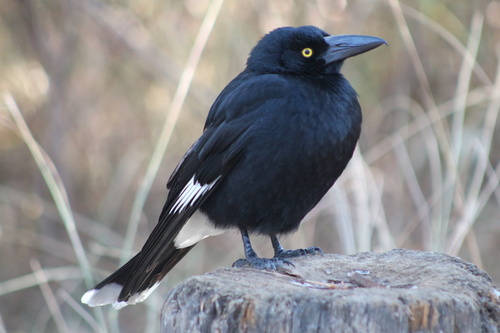
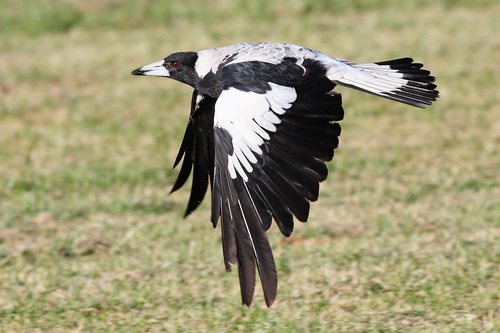
Adult Australian magpies (Gymnorhina tibicen) measure 37 to 43 cm (14.5 to 17 in) in length, have a wingspan of 65–85 cm (25.5–33.5 in), and weigh 220–350 g (7.8–12.3 oz). They have a robust, wedge-shaped bluish-white bill bordered with black, ending in a small hook, and long, strong black legs. Their plumage is glossy, solid black and white: all subspecies of both sexes have black heads, wings, and underparts, with white shoulders. The tail has a black terminal band. Males have a white nape, while females have a light greyish-white nape. Mature individuals have dull red eyes, which distinguishes them from currawongs (with yellow eyes) and Australian ravens and crows (with white eyes).
The key difference between subspecies is the 'saddle' marking on the back below the nape. Black-backed subspecies have a black saddle and a white nape. White-backed subspecies have an entirely white nape and saddle. Males of the Western Australian subspecies dorsalis are also white-backed, but the corresponding area on females is scalloped black. Juveniles have lighter grey and brown tones mixed into their bold black-and-white plumage. Two- to three-year-old birds of both sexes closely resemble adult females and are hard to tell apart from them. Immature birds have dark brownish eyes until they reach roughly two years of age.
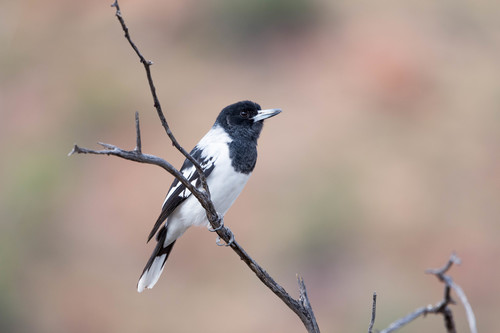
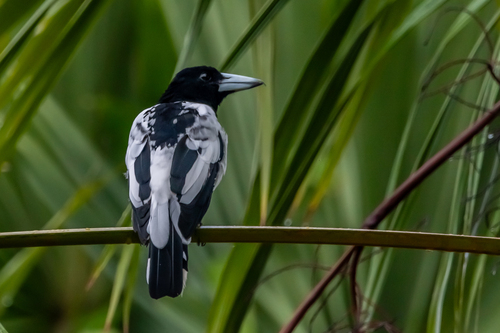
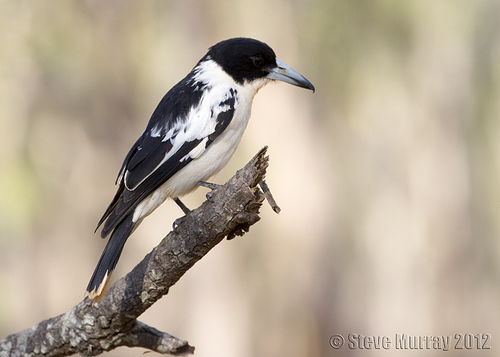
Australian magpies generally live to around 25 years old, though individuals up to 30 years old have been recorded. The reported age of first breeding varies by region, with an average between three and five years. The Australian magpie is a well-known, easily recognizable species that is rarely confused with other birds. The pied butcherbird has a similar body shape and plumage, but it has white underparts unlike the Australian magpie's black underparts. The magpie-lark is much smaller and more delicate, with a complex, very different banded black-and-white plumage. Currawong species have mostly dark plumage and heavier bills.
The Australian magpie occurs in the Trans-Fly region of southern New Guinea, between the Oriomo River and Muli Strait, and across most of Australia, excluding the tip of Cape York, the Gibson and Great Sandy Deserts, and southwest Tasmania. It prefers open habitats such as grassland, fields, and residential areas including parks, gardens, golf courses, and streets, with scattered trees or nearby forest. The birds nest and shelter in trees but forage mostly on the ground in these open areas. They have also been recorded in mature pine plantations, and only occur in rainforest and wet sclerophyll forest near cleared areas. Overall, evidence shows that the Australian magpie's range and population have increased following land-clearing, though local declines have been observed in Queensland after a 1902 drought, and in Tasmania during the 1930s. The cause of the Tasmanian decline is not clear, but rabbit baiting, pine tree removal, and the spread of the masked lapwing (Vanellus miles) have been suggested as contributing factors.