About Gymnopilus sapineus (Fr.) Murrill
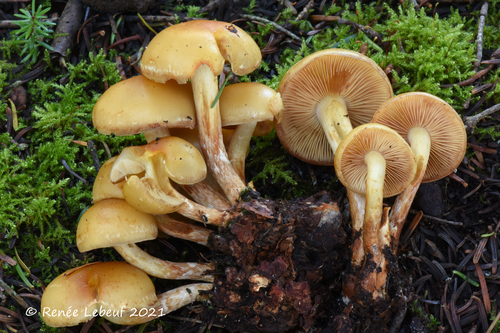
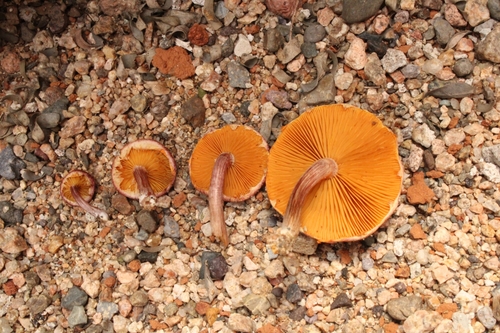
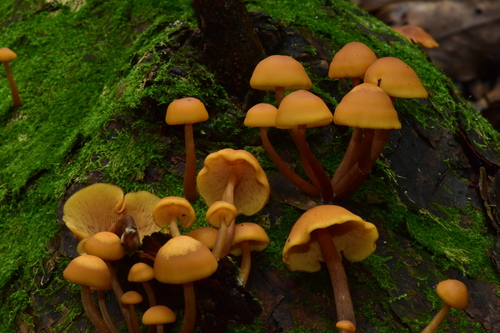
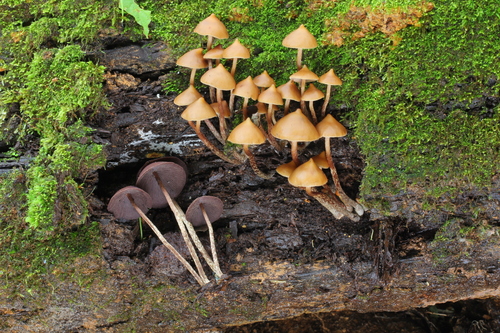
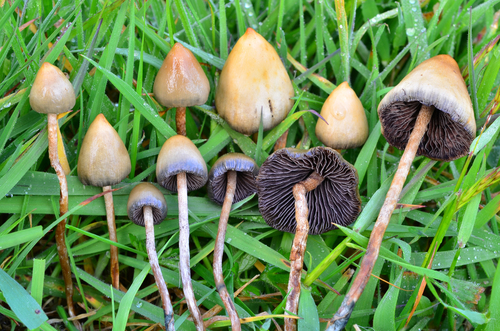
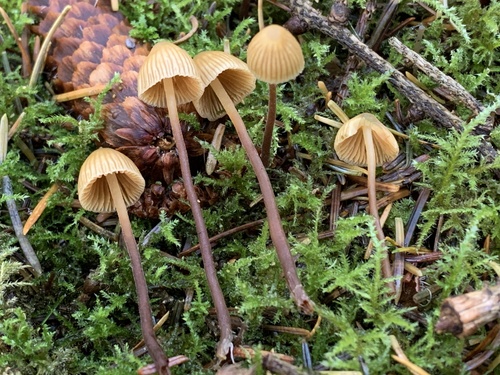
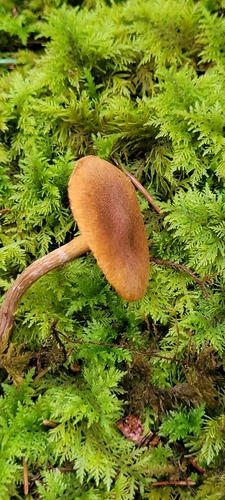
Gymnopilus sapineus (Fr.) Murrill has a cap that measures 2–8 cm across, ranges in shape from convex to flat, and is colored golden-yellow to brownish orange, darker at the center. The cap surface is dry, scaly, often fibrillose, and may bear squamules. The cap margin is inrolled when young, curves outward as the mushroom matures to become nearly flat, and sometimes develops fibrillose cracks as it ages. The flesh is yellow to orange, and more delicate than the larger, firmer flesh of other Gymnopilus species such as G. junonius. The gills are crowded, yellow when young, and turn rusty orange as spores mature, with an adnate attachment to the stipe. Spores are rusty orange to rusty brown, elliptical, rough, and measure 7–10 x 4–6 μm. The stipe is 3–7 cm long and 0.5–1 cm thick; it is either equal in structure along its length, or becomes thinner near its base. The stipe is light yellow, and bruises rusty brown when damaged. It has an evanescent veil that often leaves fragments on the upper section of the stipe or on the margin of young caps. This species sometimes has a bitter taste, and has a mild, fungoid or sweet smell. It is nonpoisonous, but considered inedible. It does not stain blue, and does not contain the hallucinogen psilocybin. This species grows on rotting wood under conifer trees throughout North America. It can generally be found from June to September across most of the continent, and from September to February on the West Coast.