About Gymnopilus liquiritiae (Pers.) P.Karst.
Scientific name: Gymnopilus liquiritiae (Pers.) P.Karst.
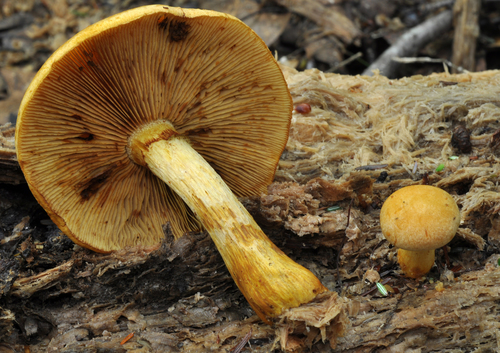
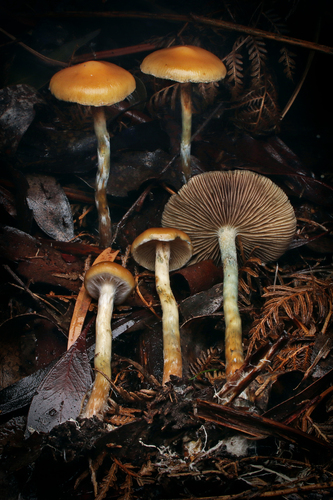
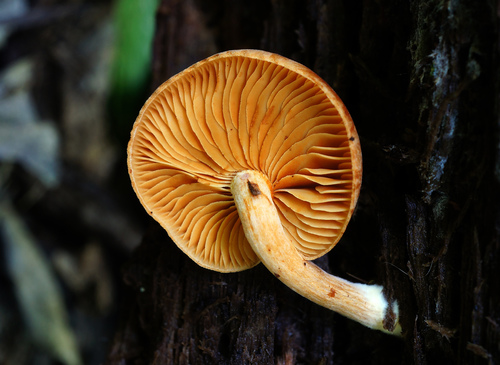
Cap: 2–8 cm in diameter; initially convex, becoming nearly plane to nearly umbonate in age. It is dry, smooth, rusty brown to orange, with an even margin that becomes striatulate, marked by small lines, grooves or ridges, at maturity and cracks slightly with age. The cap flesh is pale yellow to pale orange.
Gills: Close to crowded; broad, with fimbriate edges. They are yellowish or pale orange, eventually turning orange, and sometimes have reddish brown spots.
Spore print: Rusty orange.
Stipe: 3–7 cm long, 3–8 mm thick; more or less equal, or tapering in either direction; attachment is sometimes slightly even, or off-center. The surface is smooth or finely fibrous, colored whitish to pale orange, with yellowish or rusty colored mycelium at the base. No partial veil is present.
Taste: Bitter
Odor: Mild or sometimes similar to raw potatoes
Microscopic features: Spores are 7–8.5 x 4–5.5 μm, elliptical; pleurocystidia are inconspicuous, while cheilocystidia, pileocystidia and caulocystidia are present.
Habitat and growth: Gymnopilus liquiritiae is a widely distributed wood rotting mushroom that grows subcaespitose on conifers, and seems to prefer dead hardwood in the southern regions.