About Gymnogyps californianus (Shaw, 1797)
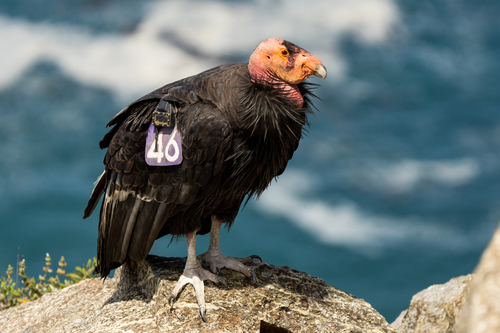
Adult California condors (Gymnogyps californianus) are uniformly black, except for large triangular white patches or bands on the underside of their wings. They have gray legs and feet, an ivory-colored bill, a frill of black feathers surrounding the base of the neck, and brownish red eyes. Juveniles are mostly mottled dark brown with blackish coloration on the head, and have mottled gray (instead of white) on the underside of their flight feathers. The condor's head has little to no feathers, which helps keep it clean when feeding on carrion. The skin of the head and neck can flush noticeably in response to an emotional state, and skin color ranges from yellowish to a glowing reddish-orange. California condors do not have true syringeal vocalizations, and can only produce a few hissing or grunting sounds that are only audible when the listener is very close. Female condors are smaller than males, which is an exception to the usual pattern among birds of prey; the related Andean condor is another exception to this rule. Overall body length ranges from 109 to 140 cm (43 to 55 in), wingspan ranges from 2.49 to 3 m (8 ft 2 in to 9 ft 10 in), and weight ranges from 7 to 14.1 kg (15 to 31 lb). Estimated average weight falls between 8 to 9 kg (18 to 20 lb). While wingspans up to 3.4 m (11 ft) have been reported, no wingspan over 3.05 m (10.0 ft) has been verified. Most existing measurements come from captive-raised birds, so it is difficult to confirm whether major differences exist between wild and captive condors. California condors have the largest wingspan of any North American bird. Only the trumpeter swan and introduced mute swan surpass them in both body length and weight; the American white pelican and whooping crane also have longer bodies than the condor. Condors are so large that they can be mistaken for a small distant airplane, a case that likely happens more often than condors being mistaken for other bird species. The middle toe of the California condor's foot is greatly elongated, and the hind toe is only slightly developed. The talons on all toes are straight and blunt, making the foot more adapted for walking than for gripping. This structure is more similar to that of storks (thought to be their close relatives) than to birds of prey and Old World vultures, which use their feet as weapons or grasping organs. When humans first settled the Americas, the California condor was widespread across the continent; late Pleistocene condor bones have been found at the Cutler Fossil Site in southern Florida. After the last glacial period, the extinction of megafauna led to a subsequent reduction in the condor's range and population. Five hundred years ago, California condors ranged across the American Southwest and West Coast, and condor faunal remains have been documented in Arizona, Nevada, New Mexico, and Texas. The early 19th century Lewis and Clark Expedition reported sighting and shooting California condors near the mouth of the Columbia River. In the 1970s, two Condor Observation Sites were established in the Santa Clara River Valley for birdwatchers hoping to see this endangered species: one 15 miles north of Fillmore, California, near the Sespe Wildlife Area of Los Padres National Forest, and one atop Mount Pinos, accessible from a dirt road off the highway from Gorman. California condors inhabit rocky shrubland, coniferous forest, and oak savanna, and are often found near cliffs or large trees, which they use as nesting sites. Individual birds have an extremely large home range, and have been recorded traveling up to 250 km (160 mi) searching for carrion. Two sanctuaries, Sisquoc Condor Sanctuary in the San Rafael Wilderness and Sespe Condor Sanctuary in Los Padres National Forest, were selected specifically for their high-quality condor nesting habitat. The 1992 Los Padres Condor Range and River Protection Act expanded existing wilderness by 34,200 hectares (84,400 acres) and designated 127,900 hectares (316,050 acres) of new wilderness that provides habitat for condors in the Los Padres area. In 2014, Condor #597, also known as "Lupine", was spotted near Pescadero, a coastal community south of San Francisco. Lupine had been seen regularly at Pinnacles National Park after being released into the wild at Big Sur the previous year. Younger birds from the central California population are expanding their territory, which suggests that further range expansion is possible for the more than 60 free-flying condors in central California. Also in 2014, the first successful condor breeding in Utah was reported: a pair of condors released in Arizona nested in Zion National Park and hatched one chick. The 1000th chick hatched since the start of recovery efforts hatched in Zion in May 2019. In late May 2020, California condors were spotted in Sequoia National Park for the first time in nearly 50 years. As part of a reintroduction effort led by the Yurok tribe to return condors (called prey-go-neesh in the Yurok language) to the coastal redwoods of northern California, birds hatched at the Oregon Zoo and the World Center for Birds of Prey were released at Redwood National Park in 2022. The first condor brought to the Yurok site was named Paaytoqin, from the Nez Perce language meaning 'Come back'; he is also known as 'Mentor' or #736. He was brought to the site but not released, to teach younger condors appropriate behavior due to his calm nature and good disposition. Mentor condors act as role models and help establish a social hierarchy within a flock, an important part of flock survival. The first condor released was named Poy'-we-son (Yurok for "the one who goes ahead"), followed by Nes-kwe-chokw ("He returns"), Ney-gem' 'Ne-chweenkah' ("She carries our prayers") and 'Hlow Hoo-let' ("At last I (or we) fly!"). The young birds were comfortable together, as they had already lived together at other facilities. As of March 2024, 11 birds (4 females and 7 males) have been successfully introduced, with another 5 or more planned for release the same year. A November 2023 article in the North Coast Journal describes all 11 birds with their names and translations. By the end of November 2024, 18 condors had been released at the site. The California condor's large flight muscles are not anchored by a correspondingly large sternum, which means the species is primarily adapted for soaring. Birds flap their wings when taking off from the ground, but after reaching a moderate elevation they mostly glide, and can travel miles without flapping their wings once. They have been recorded flying at speeds up to 90 km/h (56 mph) and at altitudes up to 4,600 m (15,100 ft). They prefer to roost on high perches, where they can launch into flight without needing significant wing-flapping effort. They are often seen soaring near rock cliffs, using thermals to help stay aloft. California condors have a long lifespan, reaching up to 60 years. If an individual survives to adulthood, it has few natural threats other than humans. Because they lack a syrinx, their vocalizations are limited to grunts and hisses. Condors bathe frequently and can spend hours each day preening their feathers. They also practice urohidrosis, defecating on their legs to lower body temperature. Large condor groups have a well-developed social structure, with competition to establish a pecking order determined by body language, competitive play behavior, and a variety of hisses and grunts. This social hierarchy is most visible when the birds feed, with dominant birds eating before younger individuals. California condors have a low clutch size (one young per nest) and reach sexual maturity late (around 6 years of age), which makes the species vulnerable to human-caused population decline. Inbreeding may be linked to increased rates of fatal chondrodystrophic dwarfism in wild condors, as well as a syndrome that produces 14 rather than the typical 12 tail feathers. However, a 2021 study found a surprising level of genomic diversity in condors. This data allows conservation strategies to be refined, helping mitigate the effects of inbreeding. One of the study's authors aims to complete genomic analysis of all 22 founding individuals that all living condors descend from. Lead poisoning is a major threat to California condors and other avian and terrestrial scavengers. Fragmented lead ammunition from large game carcass waste is highly dangerous for condors, due to their extremely strong digestive juices. Blood lead analysis of wild condors shows that lead isotope signatures match those from ammunition purchased by researchers in areas where affected condors range. In California, the Ridley-Tree Condor Preservation Act went into effect on July 1, 2008, requiring hunters to use non-lead ammunition when hunting within the condor's range. Blood lead levels in golden eagles and turkey vultures have declined since the act was implemented, showing that the legislation has helped reduce lead exposure for other species besides the California condor. No similar anti-lead bullet legislation exists in other states where condors live. In 2015, Bruce Rideout, director of the wildlife disease laboratories for San Diego Zoo Global, stated that lead poisoning is the most common cause of death for juvenile and adult condors in the wild. Among wild condor deaths with known causes between 1992 and 2013, over 60% of deaths (excluding chicks and fledglings) were caused by lead poisoning. Due to the condor's long lifespan (over 50 years), relatively late sexual maturity (around 6 years), and small clutch size (one egg every one or two years), the species is very poorly adapted to withstand the neurotoxic effects of lead exposure. According to epidemiologist Terra Kelly, until all natural food sources are free from lead-based ammunition, lead poisoning will continue to threaten the recovery of naturally self-sustaining wild condor populations. Researchers and veterinarians working on the condor recovery program note that hunters who use lead-free ammunition actually provide critical food sources for condors and other scavengers, but they caution that using lead ammunition poses a serious, preventable threat to condors and other wildlife.