About Gymnoderus foetidus (Linnaeus, 1758)
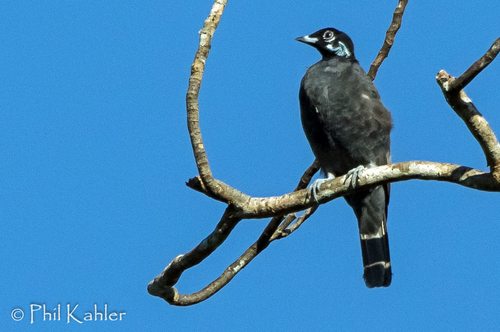
The bare-necked fruitcrow (Gymnoderus foetidus) is 34 to 39 cm (13 to 15 in) long, and one recorded individual weighed 220 g (7.8 oz). Both sexes have bare blue or bluish white skin on their lower face and neck; this skin is draped in folds on both sexes, though the folds are much less prominent on females than on males. The remainder of their heads are covered in short, velvety feathers, and their flanks bear large patches of powder down. Apart from their bare facial and neck skin, adult males are mostly black, with most of their wing colored silvery gray. Females are smaller than males; adult females are mostly slaty gray with a faint paler scaly pattern. Juveniles are mostly white, and immatures transition from this juvenile plumage to full adult plumage over two to three years.
The bare-necked fruitcrow is primarily native to the Amazon Basin. Its range extends around most of the Negro River watershed in the northern portion of the Amazon Basin, and also includes the Orinoco River basin. One segment of its range stretches from far eastern Colombia and southwestern Venezuela across far northern Brazil and the Guianas to the Atlantic coast, then extends south to connect with the main part of the species' range. The majority of the species' range runs from south-central Colombia, eastern Ecuador, and eastern Peru, eastward through northern Bolivia and north-central Brazil. In Brazil, the northern edge of the main range runs roughly from west-central Amazonas east to Amapá, and its southern edge runs from northern Mato Grosso do Sul northeast to the Atlantic coast in Maranhão.
The bare-necked fruitcrow lives in humid forest, including both várzea and terra firme forest types. It is most commonly found along rivers and around lakes. In terms of elevation, it occurs below 500 m (1,600 ft) in Colombia, below 300 m (1,000 ft) in Ecuador, below 600 m (2,000 ft) in Peru, and below 150 m (500 ft) in Venezuela.