About Gymnocrotaphus curvidens Günther, 1859
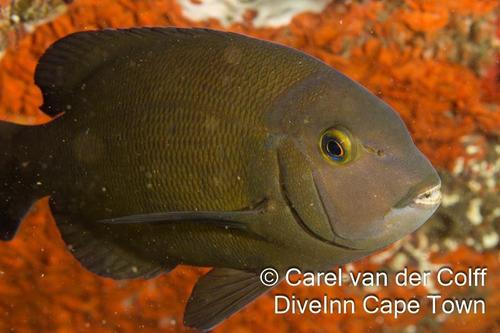
The scientific name of this species is Gymnocrotaphus curvidens Günther, 1859. For fish of the genus Gymnocrotaphus, the head is mostly scaleless (naked), with only a few scales present on the gill cover. Each jaw holds a band of curved, incisor-like teeth. Inside this band lies a second band of smaller conical teeth, and inside the conical teeth are very small molar-like teeth. The dorsal fin is supported by 10 spines and 11 or 12 soft rays. The anal fin is supported by 3 spines and 9 or 10 soft rays. The body is relatively plump and deep; the body depth fits into the fish's standard length 2.3 times. The dorsal profile of the head is concave both in front of the eyes and just above the eyes. In life, the body is coppery brown, with a bluish grey head and blue eyes. Orange lines run along each scale row. The maximum published total length for this species is 50 cm (20 in). Gymnocrotaphus curvidens is endemic to the coasts of South Africa, ranging from False Bay in the Western Cape to Port St. Johns in the Eastern Cape, within the southeastern Atlantic and southwestern Indian Oceans. It occurs at depths between 1 m and 80 m, and lives on shallow reefs.