About Gymnocarpium disjunctum (Rupr.) Ching
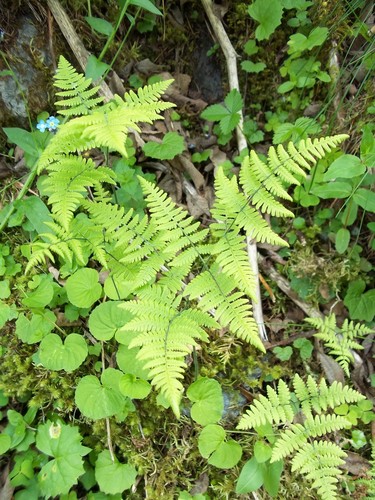
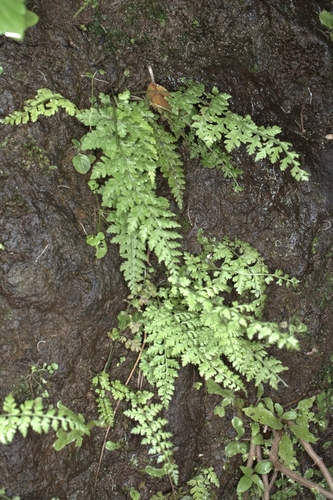
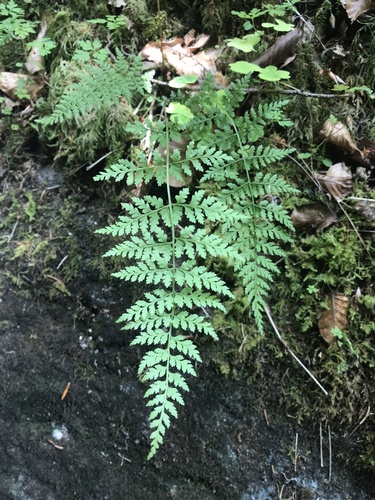
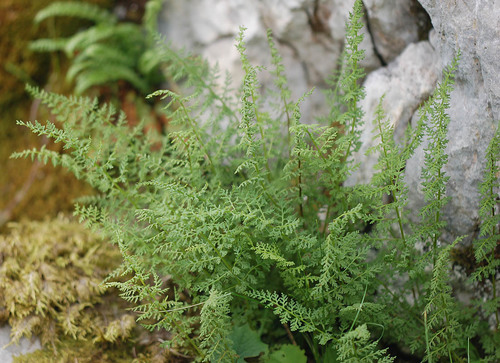
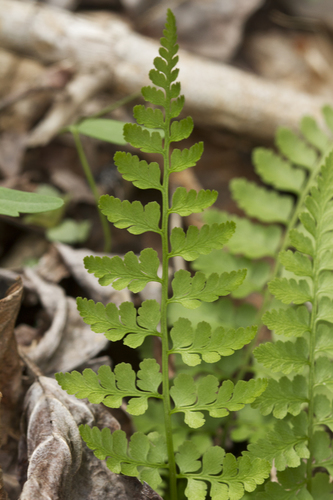
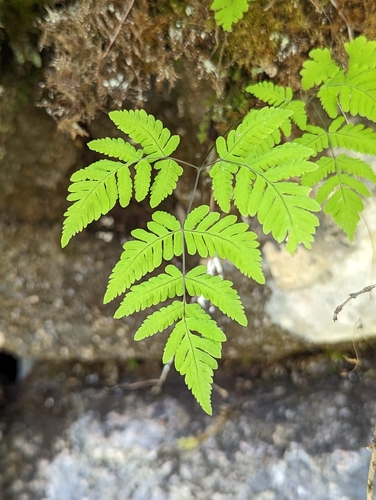
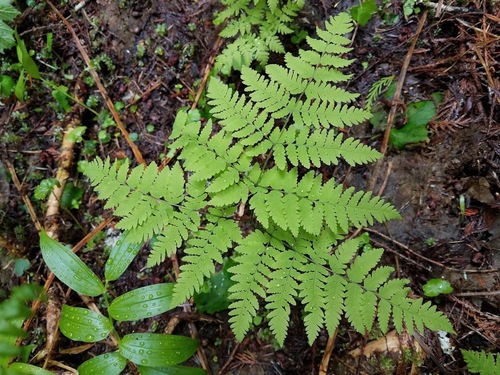
Gymnocarpium disjunctum (Rupr.) Ching is a fern with medium green, delicate-looking leaves that grows from a long, slender, creeping rhizome. Its leaves do not grow from a single central point; instead, they emerge individually from the creeping rhizome, often forming loose groupings across the forest floor. The leaf stalks (stipes) measure 1–3 mm in diameter and 12–44 cm in length, and have sparse glandular hairs on their upper sections. Both the stipes and the midribs of the leaf blades range in color from brownish green to black. The full leaves are bright to medium green, 20–68 cm long, with a broadly triangular deltate blade, and have a division pattern ranging from 3-pinnate to pinnatifid. The lower (abaxial) leaf surface and the central rachis are either hairless (glabrous) or have sparse glandular hairs, while the upper (adaxial) leaf surface is always glabrous. The largest pinnae (leaf subdivisions) grow up to 18 cm long, and are held almost perpendicular to the central rachis. Pinnae gradually decrease in size toward the tip of the leaf, ending in a divided triangular leaflet at the apex. Sori (spore clusters) grow in a single row on each side of the pinna midrib near the tip of the leaf blade, and become more crowded and less regularly arranged closer to the base of the blade. In autumn, the leaves lose most of their color, turning very pale and sometimes nearly pure white. This species is native to coastal northeast Asia, Alaska, and British Columbia; its range extends south to Oregon and Washington, and inland to interior southern British Columbia, Idaho, Montana, and Wyoming. It grows in shaded areas within moist coniferous forests.