About Gymnocalycium saglionis (Cels) Britton & Rose
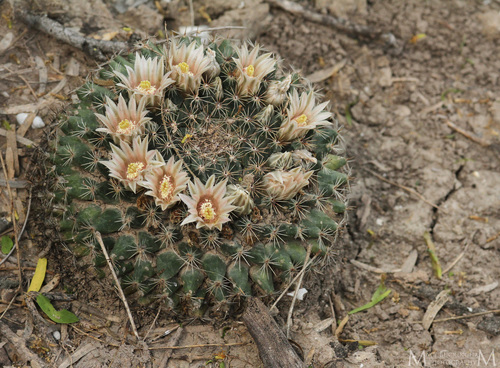
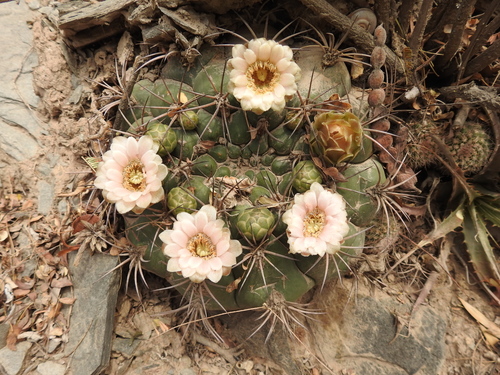
Gymnocalycium saglionis is recognized as a very slow-growing cactus that grows best in warm, partially shaded conditions. It can tolerate extremely bright locations, but it is likely to develop sun scorch or stunted growth if overexposed to direct summer sunlight during the hottest part of the day. The cactus body ranges in color from dull-green to blue-green, and is generally cylindrical with a somewhat flattened shape. Mature specimens can reach up to 40 cm (16 in) in diameter, and grow up to 90 cm (35 in) in height. Its spines grow to 3–4 cm (1.2–1.6 in) long, and can be yellowish-brown, reddish, or white, turning grey with age; this coloration contrasts well against the green cactus body. The species produces 1 to 3 central spines and 10 to 15 radial spines, which curve against the stem. When wet, the spines turn bright red. Its flowers are 3.6 cm (1.4 in) long, white or reddish, and often multiple flowers open at the same time. Fruits are globular, reddish or dark pink, and split sideways when mature; they contain small, shiny black-brown seeds. In its native range, this cactus is most commonly found in the Argentine provinces of Salta, Tucuman, Catamarca, San Juan, and La Rioja, growing at elevations between 240 and 2,600 meters. It grows on rocky soil alongside other low vegetation, including the species Acanthocalycium leucanthum and Leucostele terscheckii. Gymnocalycium saglionis is cultivated as an ornamental plant worldwide, and is commonly available for purchase. The species is popular among cactus collectors due to its large size and thick curved spines. In the United Kingdom, it has been awarded the Royal Horticultural Society's Award of Garden Merit.