About Gundelia tournefortii L.
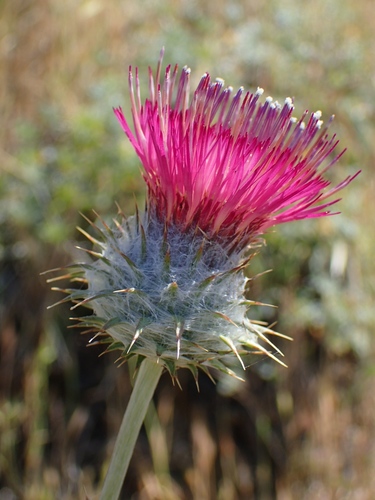
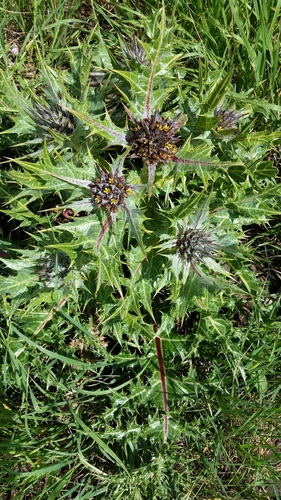
Gundelia tournefortii L. is a spiny hemicryptophyte, with stems that grow 20–100 centimetres (8–39+1⁄2 inches) long and branch from the plant's base. Early growth of the plant forms a rosette of leaves, and all parts of the plant contain milky latex. After maturity, the above-ground portions detach from the root and can blow away as a tumbleweed, which helps disperse the plant's seeds. All chromosome counts completed to date show the species has 18 chromosomes (2n=18).
This species is most abundant in the Eastern Anatolia region of Turkey, specifically in the province of Muş. In autumn, dried yellow layers of the plant cover entire mountains, to an extent that the coverage is visible even from space. Its native range includes Cyprus, Anatolia (Turkey), Armenia, Azerbaijan, Northern Iraq, northern Iran, Israel, Afghanistan, western Syria, Turkmenistan, Kazakhstan, Uzbekistan, Palestine, Lebanon, Jordan, and Egypt; it has also been introduced to Algeria.
Gundelia tournefortii grows on limestone, igneous rock, or reddish soils. It occurs in steppe, open oak or pine woodland, between coppices, as a weed in barley or cornfields, in fallowed or abandoned fields, and along roadsides. It can be found at altitudes up to 2500 metres. It is pollinated by insects, including honey bees and pollen-feeding beetles such as the garden chafer.
For cultivation, Gundelia seeds germinate slowly and may take several years to sprout. Seedlings can be planted outdoors, but require bright light, well-drained soil, and protection from frost. Growth is slow during the plant's first year. It can be grown in rock gardens or on raised beds, and is likely hardy to around −15 °C when drainage is good. It has been grown intermittently at the École de Botanique and what is now the Jardin des Plantes in Paris since the 18th century.
As a food plant, early in the year wild Gundelia plants are cut at the base and have their thorns removed. The leaves, stems, roots, and especially the undeveloped flower heads are edible. The base of young leaves, which still grows under the soil surface, is used by Bedouin and Arab communities to make akkub soup. In the West Bank, young flower heads, stems and leaves are collected between March and May, then fried in olive oil, mixed into a stew of chopped meat until fully cooked, and served mixed with yogurt. Gundelia is described as having a flavor between asparagus and artichoke. Another traditional preparation is stuffing trimmed inflorescences into meatballs, frying the meatballs in olive oil, then simmering them in a lemon juice sauce. In the mountainous area of south Kurdistan (Iraqi Kurdistan), Gundelia is still used as a vegetable. In Palestine, where it counts among the few wild edible native plants, commercial collection for markets has caused a decline in the local plant population, and the Israeli occupation restricts collection to personal use only. In Syria, akkoub is traditionally baked into pies.
A chewing gum can be made from the plant's latex; this use was already recorded by Tournefort in 1718, and the gum is called "kenger sakızı" in Turkish. The fruits and roots can be roasted and ground to use as a coffee substitute, called "kenger kahvesi" in Turkish. In modern times, mature seeds have been used to extract oil. Remains of charred Gundelia inflorescences from the Neolithic period found in Turkey and Iraq indicate that seed oil was pressed from this plant at least 10,000 years ago. The seeds are edible; in Iraq they are called سِسّي "Sissi", dried, salted and roasted, and sold in nut shops, with a flavor similar to sunflower seeds. The cypselas contain almost 7% oleic acid and 12½% linoleic acid, making the oil comparable in composition to soybean, corn, sunflower and sesame oils. Commercial use of Gundelia as an oil crop would depend on plant breeding to improve crop yield, harvest suitability, and suitability for food processing, such as selection for spineless plants.
In traditional medicine, Gundelia is used to treat a wide range of ailments, including liver diseases, diabetes, chest pain, heart attacks, stomach pain, leukoderma, diarrhea and bronchitis.