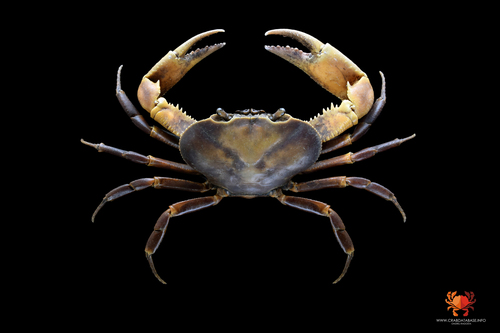
About Guinotia dentata (Latreille, 1825)
Guinotia dentata has an almost oval body shape, with very small teeth along its carapace. Its overall coloration is yellow-brown, and its carapace can reach 65 millimetres (2.6 in) in length, with a length that is approximately three-fifths its width. Its eyestalks are yellow, while the corneas are black. The most distinguishing feature of the species is its large yellow claws, which have straight, sharply pointed fingers. Some individuals have an almost entirely yellow dorsal carapace surface, with brown color along the submarginal area. The cervical groove on the carapace follows a meandering curve that does not quite reach the edge of the shell. Around 24 distinct areoles are clearly defined on the shell. The forehead is low, excavated, depressed, and of uniform height. Its pereiopods are unremarkable in size and shape, and the chelae lack prominent, swollen protuberances on the outer surface near the base of the fingers.
This species is native primarily to the islands of Dominica, Guadeloupe, Martinique, and Saint Lucia in the Lesser Antilles. It is not found in the Virgin Islands. Its distribution is fragmented across these separate islands, but it is abundant in the regions where it occurs. Guinotia dentata lives mostly in streams—particularly shady streams—and ponds, and may sometimes be found on land, though it avoids excessively dry areas. It has never been observed in estuaries. It inhabits highland streams and rivers across the Lesser Antilles, and has been recorded at altitudes up to 2,850 ft (870 m). It is confirmed to inhabit Boeri Lake, and may also be present in Freshwater Lake. Individuals hide under tree roots, rocks, and rotting wood, where they dig shallow, oval-shaped burrows.
Habitat destruction is the largest threat to Guinotia dentata. A protected area has been established on Dominica to conserve this species. All reproduction for the species occurs entirely in fresh water, and breeding takes place year-round with no distinct breeding season. The young undergo direct development, hatching as juvenile individuals rather than passing through any free-living larval stages. Females carry the eggs, and continue to protect the young for a period after they hatch.

