About Guettarda speciosa L.
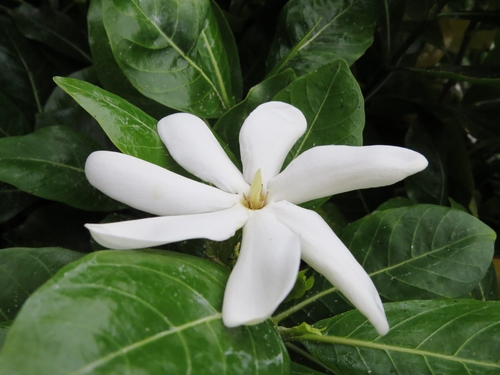
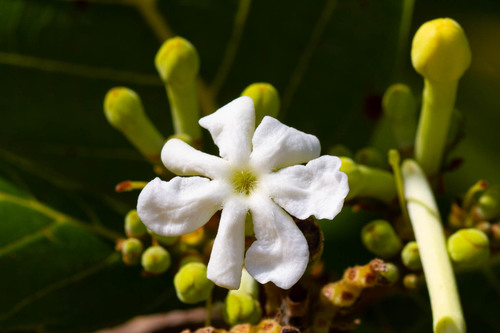
Guettarda speciosa L. is a perennial shrub or small tree that reaches 2–6 m (7–20 ft) in height and 1–3 m (3.5–10 ft) in width, with smooth creamy grey bark. Its large oval leaves measure 15–23 cm (6–9 in) long and 10–18 cm (4–7 in) wide; they are dark green and smooth on the upper surface with prominent paler veins, and finely hairy on the lower surface. Flowering occurs from October to May, and the blooms are fragrant white flowers 2.5–3 cm (1–1+1⁄4 in) long with 4 to 9 lobes. After flowering, it produces sweet-smelling, globular hard fruit that measures 2.5 cm–2.8 cm × 2.2 cm–2.5 cm (0.98 in–1.10 in × 0.87 in–0.98 in), which mature from September to March. This species grows in coastal tropical habitats around the Pacific Ocean. In Australia, it occurs along the coastlines of central and northern Queensland and the Northern Territory. It is also found across Pacific Islands including Micronesia, French Polynesia and Fiji, as well as Malaysia, Indonesia, the Maldives, and the east coast of Africa. Commonly called beach gardenia, it grows on beaches and sandy areas located above the high tide mark. The timing of this plant's night-time flower opening indicates it is pollinated by moths. On Christmas Island, the Christmas white-eye (Zosterops natalis) visits its flowers, while the Christmas Island red crab (Gecarcoidea natalis) eats fallen fruit. The Mariana Fruit Bat (Pteropus mariannus) feeds on both the fruit and flowers, and acts as a seed dispersal vector. Indigenous peoples have used this plant in many ways. Indigenous people of northern Australia used its large leaves to hold food; heated leaves were also applied to relieve headaches and limb aches. Stems can be used to make Macassan pipes. On the Cook Islands, flowers are used to scent coconut oil, and the wood is used to build dwellings and canoes. The Marshallese people of Kwajalein consider the plant to hold spiritual power. Guettarda speciosa is a very useful plant for seaside planting in tropical climates. It requires full sun and well-drained soil. It has proven difficult to propagate, as propagation must be done by seed, which can take months to germinate.