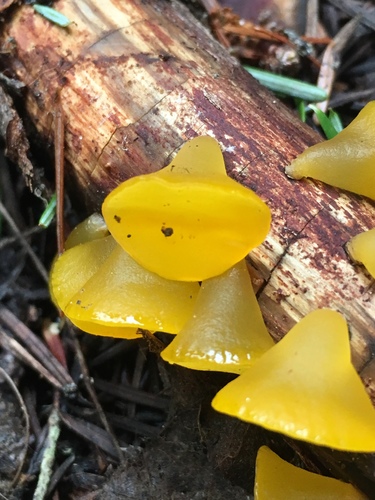
About Guepiniopsis alpina (Tracy & Earle) Brasf.
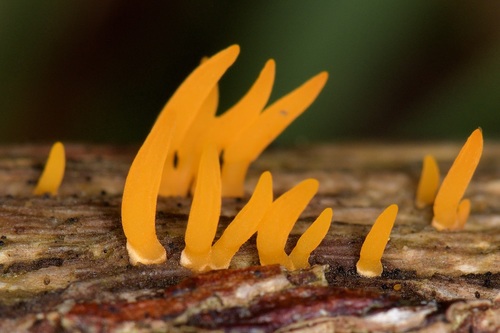
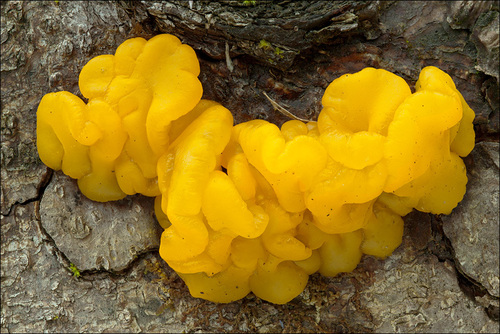
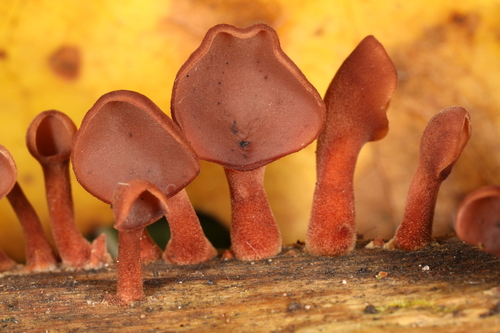
The fruit bodies of Guepiniopsis alpina are cone-shaped, reaching up to 2.5 cm (1 inch) across. They hang from a narrow point of attachment to their growing substrate. Their color ranges from bright yellow to orange, they have a gelatinous texture, and their upper surface is smooth and sticky, while the outer surface bears hairs. Dried fruit bodies darken to a reddish-orange shade and become hard. Basidiospores are produced on the inner surface of the cup-shaped structure, and are yellowish in spore deposit. The spores are sausage-shaped, measuring 11–18 by 4–6 μm, and have three or four septa. Like all species in the class Dacrymycetes, the basidia of Guepiniopsis alpina are Y-shaped. Fruit bodies grow scattered, in groups, or in clusters on decaying conifer wood that has no bark remaining. As a snowbank fungus, it is most common at higher elevations after snowmelt in the spring. It occurs in North America west of the Rocky Mountains. It was first recorded in Iran in 2010, and it may also be present in Sweden.