About Guaruba guarouba (Gmelin, 1788)
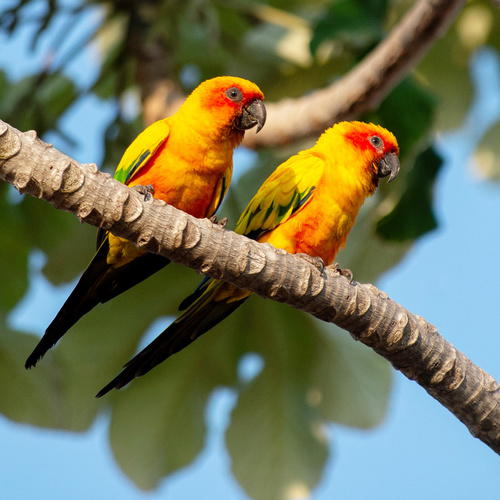
The golden parakeet, whose scientific name is Guaruba guarouba (Gmelin, 1788), measures 34–36 cm (13–14 in) in length. Its plumage is mainly yellow, with green coloring on the outer wings and an entirely yellow tail. It has a large horn-colored (gray) beak, bare pale-pink eye rings, brown irises, and pink legs. Adult males and females have identical external appearances. Juvenile golden parakeets have duller overall plumage, with less yellow and more green than adult birds. A juvenile's head and neck are mostly green, its back is a mix of green and yellow, the upper side of its tail is mostly green, and its breast is greenish. Juveniles also have pale-gray eye rings and brown legs. This species' estimated total range covers around 174,000 km², located between the Tocantins, lower Xingu, and Tapajós Rivers in the Amazon Basin south of the Amazon River, in the state of Pará, northern Brazil. Additional recorded sightings come from adjacent northern Maranhão. A 1986 study found that golden parakeets use two distinct habitats across the year. During the nonbreeding season, which aligns with the dry season, they occupy tall forest. During the breeding season, they leave tall forest to enter open areas along forest edges, including agricultural fields. Golden parakeets are a social species; they live, feed, sleep, and even breed together. In the wild, they have a varied diet, feeding on fruits including mango, muruci, and açai, as well as flowers, buds, seeds such as those of Croton matouensis, and crop plants, particularly maize.